Balancing Kinetics and Kinematics in NFL and NBA Training
Available in:
EN

Balancing Performance Outputs and Movement Quality
Effective athletic development requires coaches to consider kinetics and kinematics together, supporting both performance and injury resilience. Testing athlete performance and health-related qualities can then help coaches identify development needs and make more informed training decisions. At Miami Speed Lab, assessment foundations combine data from technologies such as ForceDecks and SmartSpeed with a coach’s visual assessment of athlete movement.
Concurrent improvements in movement strategy and maximal performance are a best-case scenario. However, training programs often focus on one or the other, leading to quality outputs paired with a poor movement strategy, or an efficient movement strategy paired with limited outputs.
Therefore, how a movement is executed matters as much as what result it produces. A jump that sets a personal record in jump height can be seen as a valuable output but may still be flagged if landing mechanics show inefficiencies or raise concerns about injury risk.
…how a movement is executed matters as much as what result it produces.
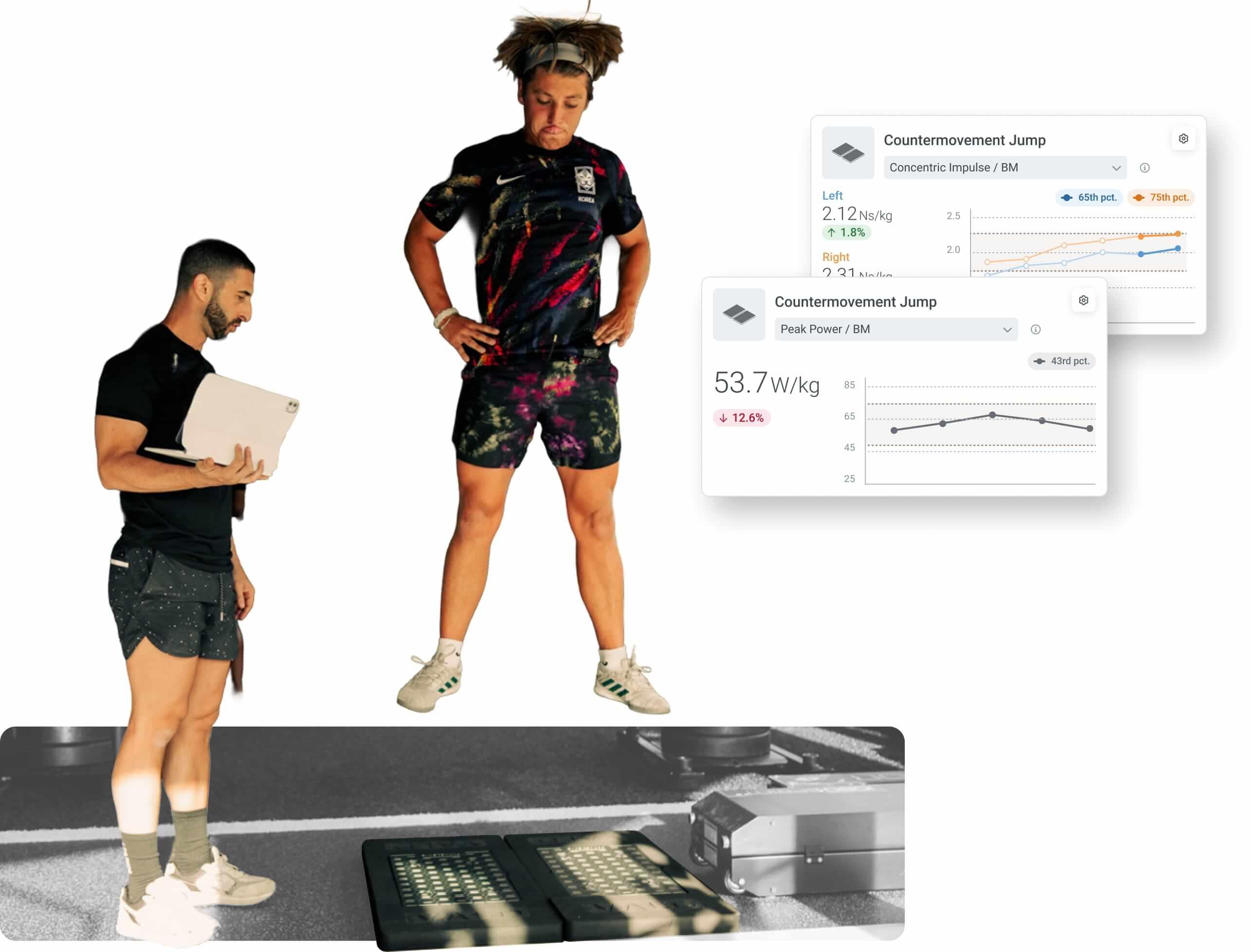
Numbers are essential for establishing baselines and showing which qualities need emphasis in training. After testing, data collected on systems such as ForceDecks is interpreted alongside visual mechanics observed during the test and on-field movement tasks relevant to sport.
This is where features like ForceDecks Vision are useful for visually analyzing movement strategy alongside countermovement jump (CMJ) metrics, such as average eccentric braking force / body mass (BM) or reactive strength index-modified (RSI-Mod). These results inform training decisions by revealing which areas of movement strategy and capacity need the most development.
For example, an athlete with a high RSI-Mod but poor deceleration mechanics when changing direction may need additional emphasis on braking capacity and movement capabilities. Based on these results, we would adjust the training volume to include additional unilateral eccentric strength exercises and corrective exercises to improve coordination during change-of-direction (COD) tasks.
For NBA athletes specifically, quality movement strategy in the ankles, hips and spine reduces load on the knees over a long season. The priority is efficient, effective movement that translates onto the court rather than isolated strength gains.
However, deficiencies in maximal outputs such as isometric peak force or jump height can mask performance deficits, as the athlete cannot expose themselves to high enough loads for deficits to appear. Therefore, an athlete who shows no major biomechanical risk factors but tests poorly in areas such as speed, deceleration capacity and jump height may require a different training program to address key areas of performance development.
Test results should improve alongside visual improvements in movement strategy, and that combination should correlate with on-field performance.
Test results should improve alongside visual improvements in movement strategy, and that combination should correlate with on-field performance. When those signals move together, what you are tracking is truly relevant.
Using Performance Testing to Profile Athletes
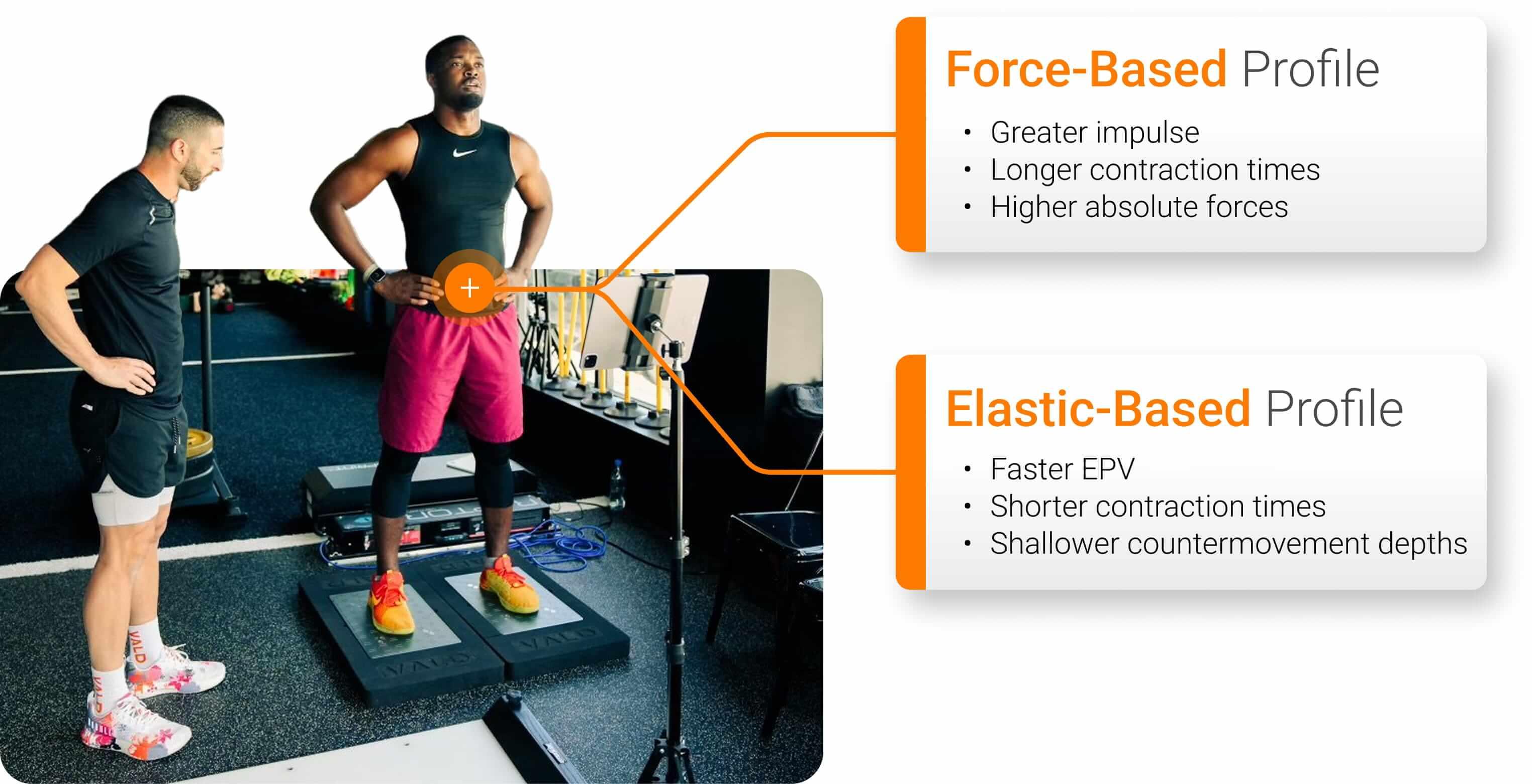
Two primary force plate tests are run using ForceDecks: a CMJ and a hop test. Comparing the two helps us categorize an athlete into a force-based or elastic-based profile, which directs how training is structured:
- Force-Based Profile: Athletes typically demonstrate greater impulse and power capabilities but often show longer contraction times, which commonly indicate a need to improve stretch-shortening cycle utilization in assessments. Training emphasis shifts toward reactive, short-ground-contact and elastic-strength work to develop the underdeveloped side of the profile.
- Elastic-Based Profile: Athletes often move efficiently and rely on faster eccentric peak velocity (EPV), quicker contraction times and shallower countermovement depths. These athletes are fast but may require greater emphasis on maximal strength and power development. Visually, these athletes may appear underdeveloped in the weight room, despite quality jump performance.
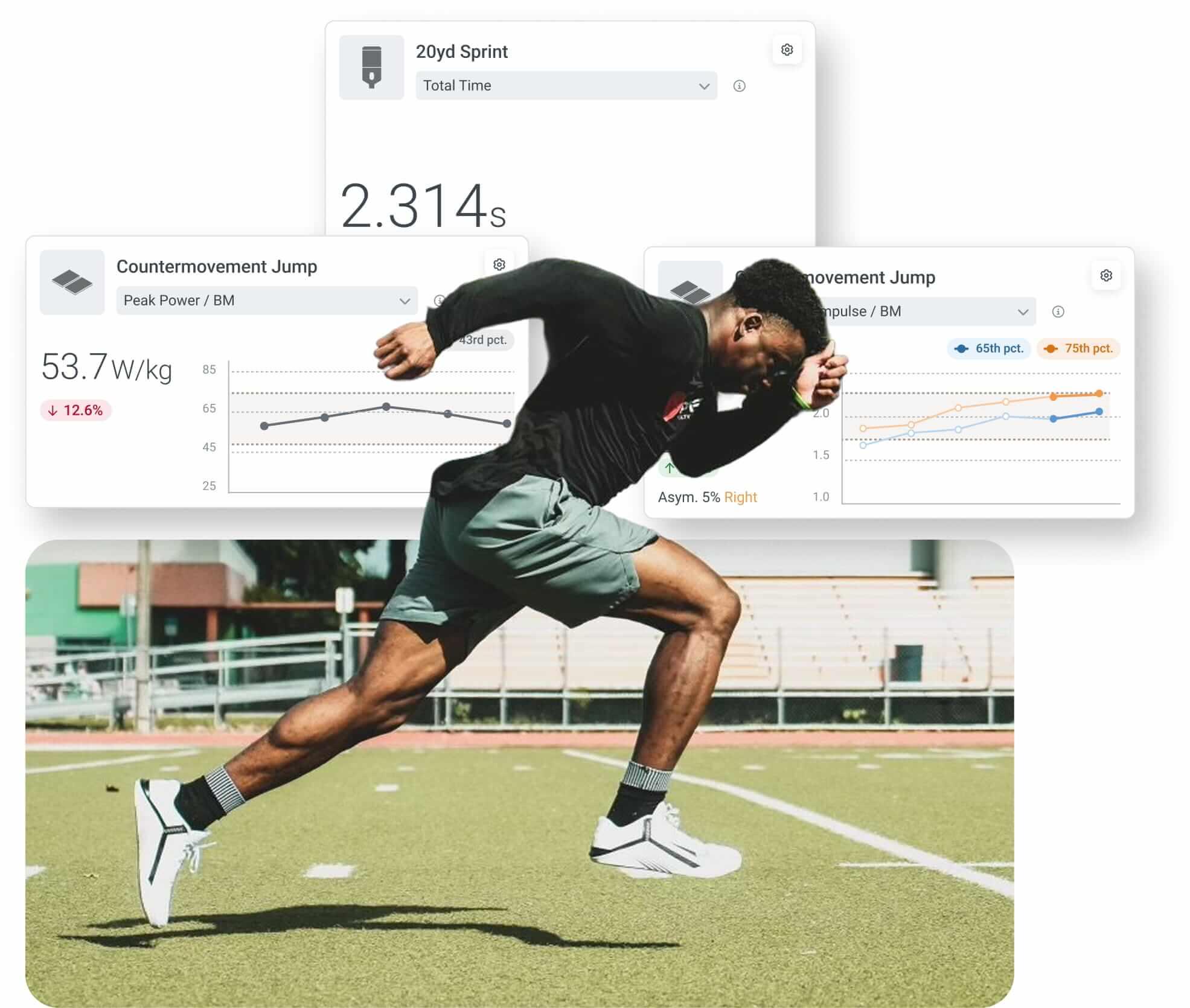
Categorizing athletes also draws on additional CMJ metrics, including peak power / BM and concentric impulse / BM, alongside the athlete’s acceleration profile on the field.
For example, an athlete may present with a powerful CMJ and high jump height but a comparatively low-performing hop test based on average jump heights and reactive strength index (RSI) scores. Results like these typically point to a lack of capacity at the foot or ankle, directing programming toward reactive strength work rather than additional maximal-strength loading.
…a powerful CMJ and high jump height [with] a comparatively low-performing hop test based on average jump heights and RSI scores …typically point to a lack of capacity at the foot or ankle…
On the field, SmartSpeed is used for force-velocity profiling sprint testing and pro agility (“5-10-5”) drills, while a broad jump serves as a simple proxy for horizontal power and acceleration capacity. Deceleration testing drills such as the curve sprint deceleration deficit can also be included in the testing battery depending on the athlete’s sport and position.
Daily wellness is also tracked through a readiness questionnaire, helping identify trends in wellness reporting, such as daily readiness and sleep scores, and their potential influence on testing data from ForceDecks and SmartSpeed.
A core set of tests is included for all NBA and NFL athletes:
| Test | Metrics | What It Corresponds to | Training Decision |
| CMJ | Average braking force / BM, countermovement depth | Lower-body power and movement strategy | Guides programming toward force qualities or short-contact, reactive work when paired with the hop test. |
| Hop Test (“10/5”) | Mean RSI (jump height / contact time) | Reactive and elastic strength as well as ankle movement capabilities | Guides programming toward force qualities or short-contact, reactive work when paired with CMJ. |
| Linear Sprint (One-Way Timing) | Split times | Acceleration mechanics and top-end speed potential | Shows whether the deficit is in mechanics or acceleration capabilities. Training shifts toward improving running mechanics or lower-body power drills like Olympic lift variations. |
| Pro Agility Drill (“5-10-5”) | Completion time | COD speed, deceleration and reacceleration | Shifts training to emphasize additional COD plyometric drills when results are subpar. If a limitation results from movement strategy, relevant corrective exercises are included in programming. |
Test results are compared with the athlete’s historical averages and population-specific normative data, such as the 2024/25 Basketball Report available in VALD Hub, and considered alongside on-field performance reports from coaching staff.
Assessing Movement Strategy Alongside Performance Testing
Visual assessment adds context to the numbers during certain movement phases, particularly during landing. This can occur within a test itself, such as a CMJ, or during a movement pattern like a squat assessment, as part of a larger movement screening process.
For example, with ForceDecks Vision, we can scrub through videos to show a technical error we want an athlete to correct. After using the visual biofeedback from the app, we can retest the athlete to determine whether the error in technique is immediately trainable or reflects a physical limitation requiring long-term intervention.
…with ForceDecks Vision, we can…show a technical error we want an athlete to correct …[and] we can retest the athlete to determine whether the error in technique is immediately trainable…
Every new athlete begins with a joint-by-joint assessment to check range of motion and tissue extensibility. At Miami Speed Lab, we place a strong emphasis on the ankles, knees, hips and spine, particularly for athletes in sports involving repeated joint impact over longer time frames.
After the initial assessment, we have all new athletes complete the testing outlined above using ForceDecks and SmartSpeed. This provides a better understanding of their kinetics and kinematics to help inform personalized programming.
Translating Testing Data into Athletic Insights
Testing and movement observation function as complementary inputs rather than competing priorities. Metrics provide an objective baseline, flag issues before they appear visually and allow progress and readiness to be tracked over time in ways visual assessment alone cannot. Movement observation adds context by showing how efficiently the body manages forces, with implications for both performance and injury risk.
The objective is not to make athletes faster, stronger or better movers in isolation, but to build a foundation of health, movement efficiency and capacity that sport coaches can build on. Objective testing, paired with what is seen on the field, is central to that foundation.
If you would like to learn more about how VALD’s human measurement technology can help you profile athletes, guide individualized programming and connect data to training outcomes, get in touch with our team.
