Defining Reactive Strength
About the Author
Dr. Lachlan James is an Associate Professor of Sport Science at La Trobe University and the Founder of ForceLab Strength Science Solutions. With over 80 peer-reviewed publications, he focuses on strength science, particularly strength diagnostics and training adaptations.
He currently supervises nine PhD students and oversees strength science projects across AFL and NRL clubs, as well as at institutes of sport, including the Queensland Academy of Sport and the Victorian Institute of Sport.
Reactive Strength Basics
Reactive strength refers to the plyometric capacity to rapidly transition from an eccentric to a concentric muscle action induced by impact loading (typically with the ground) and characterized by ground contact times (GCTs) below 250ms (James et al., 2023). It reflects how well an athlete can withstand high landing forces and rapidly redirect force to achieve a fast, efficient jump height.
Therefore, reactive strength is an indicator of how effective and efficient an athlete’s spring-like qualities are in time-constrained settings.
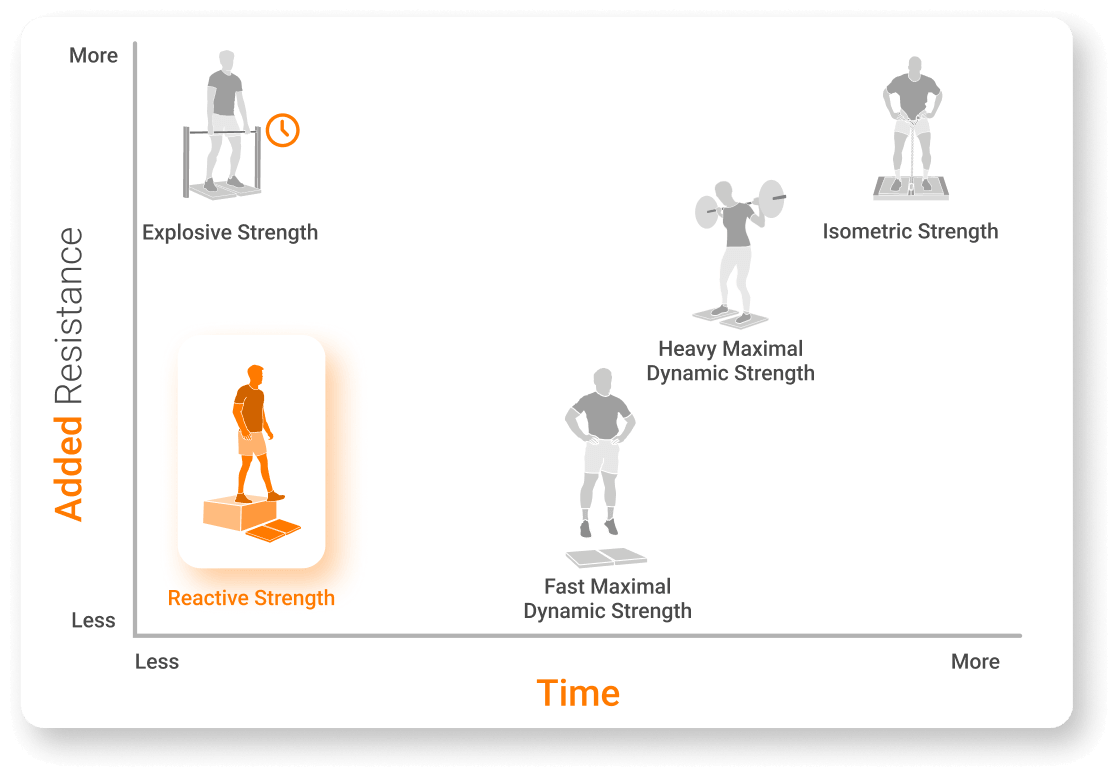
Stylized graph on strength domains adapted from James et al. (2023).
Reactive strength appears largely distinct from other strength qualities, sharing only ~10%, 20% and 30% commonality with maximal isometric, early isometric and repetition-maximum (RM) strength, respectively. Notably, it explains only 15-30% of performance in a slow stretch-shortening cycle (SSC) (>250ms contraction time) jumping action, such as a countermovement jump (CMJ).
Reactive strength [is] largely distinct from other strength qualities…[such as] maximal isometric, early isometric and RM strength…
Modern assessment technologies like ForceDecks allow practitioners to quantify reactive strength with greater precision through tests such as the drop jump (DJ) and repeated-hop tasks, equipping them to solve unique and specific strength-science problems.
Reactive Strength vs. Slow SSC Actions
A useful way to contextualize reactive strength is to contrast it with slow SSC jumping tasks (e.g., DJ vs. CMJ). While both involve eccentric-concentric coupling and high takeoff velocities, they differ fundamentally in the time available to produce force.
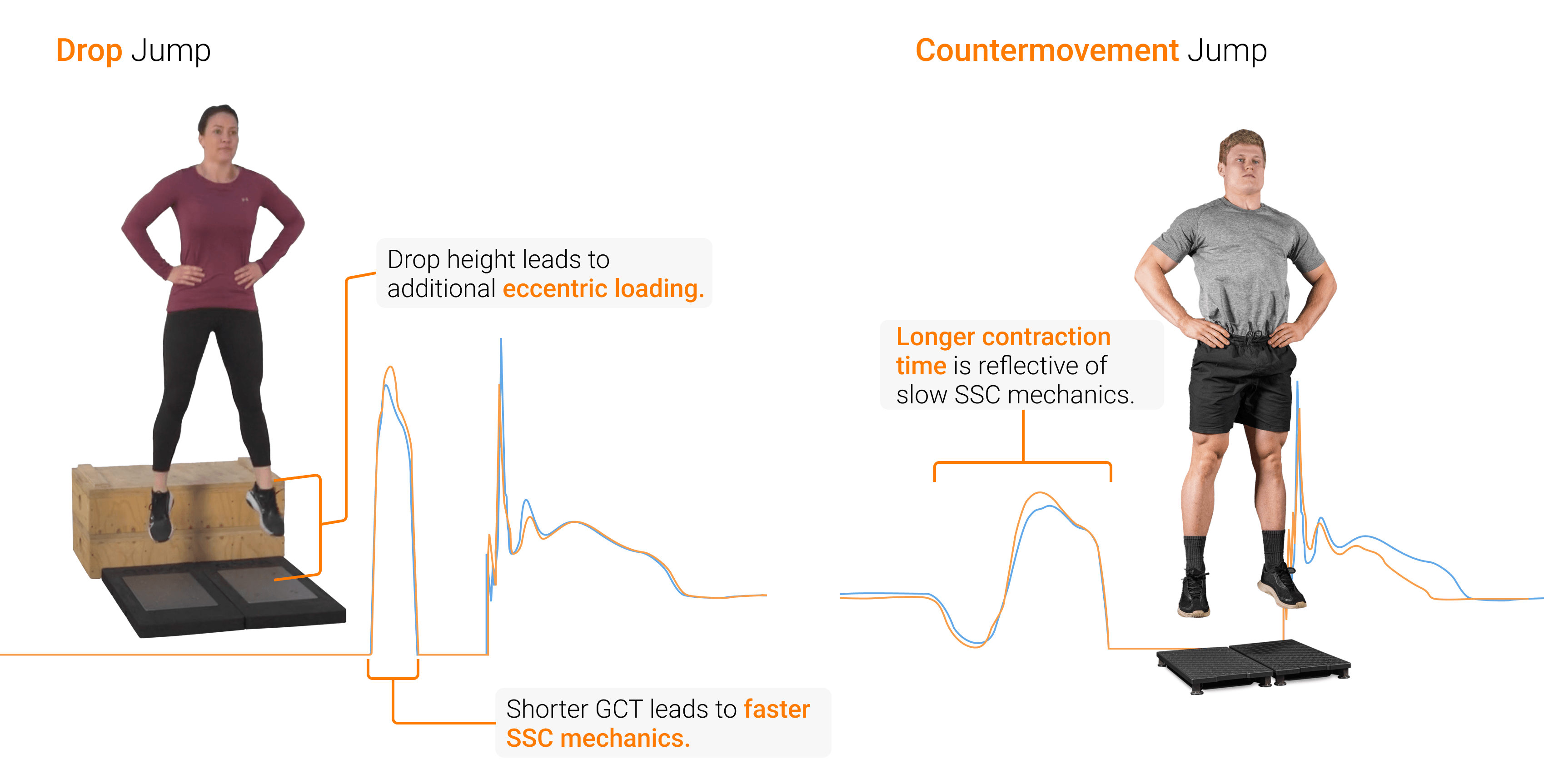
Unique force-time characteristics separating the DJ and CMJ.
Slow SSC actions are focused on producing maximal velocity at takeoff over extended movement times. They are often, but not always, self-initiated. Examples from sport include vertical jumps from a standing position (e.g., basketball rebound or volleyball block). The contraction time, or time to takeoff, for these actions can be around 800-1000ms.
In contrast, fast SSC actions (<250ms in contact or contraction time) that define reactive strength have strict time constraints. In these tasks, the athlete must rapidly redirect their impact velocity by producing a short, sharp impulse to efficiently produce a high takeoff velocity within a restricted time window.
In [fast SSC actions], the athlete must rapidly redirect their impact velocity by producing a short, sharp impulse to efficiently produce a high takeoff velocity…
Activities demanding high levels of reactive strength include:
- Sprinting and high-speed running
- Plyometric activities with quick contact times (e.g., DJs, hurdle jumps and bounding)
- Run-up jumps (e.g., long jump, triple jump, layups and spikes)
- Change of direction and agility tasks
The Quantification of Reactive Strength
Reactive strength tests involve rebound actions performed with the intent to minimize contact time and maximize displacement. The most common test is the DJ, with alternatives including the 10/5 hop test and the countermovement rebound jump. The primary outcome measure is the reactive strength index (RSI), calculated as jump height relative to contact time.

Emphasizing both jump height and contact time is critical. If height alone is prioritized, the task shifts toward a slow SSC action and reflects a different strength quality. Conversely, focusing solely on minimizing contact time yields artificially low RSI values that fail to reflect true reactive strength performance.
…focusing solely on minimizing contact time yields artificially low RSI values that fail to reflect true reactive strength performance.
To support this, real-time feedback should be provided. Reporting RSI and its components to the performer after each attempt enables targeted cueing, with stable scores indicating adequate familiarization.
Measuring reactive strength performance across multiple drop heights (via a DJ profile) allows identification of an athlete’s maximal reactive strength capacity and the height at which RSI is optimized. This can inform more precise programming, with training centered around the optimal drop height and strategically supplemented with overload exposures at greater heights.
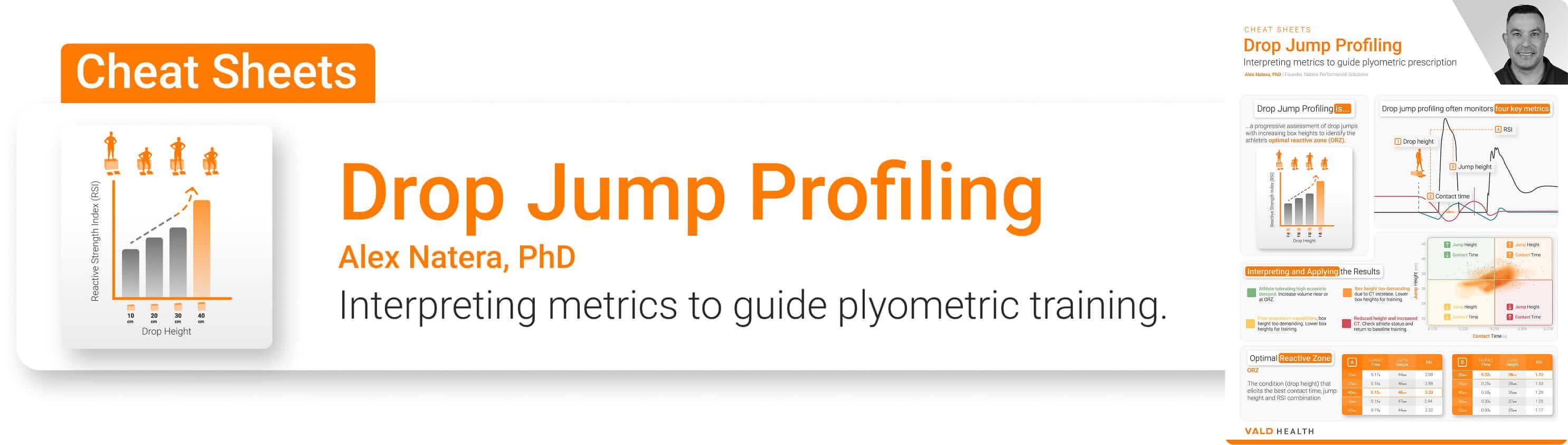
For more information about DJ profiling, see Alex Natera’s Cheat Sheet.
However, this approach is time-intensive and is best reserved for contexts where reactive strength is a key performance determinant, such as sprinting and jumping events.
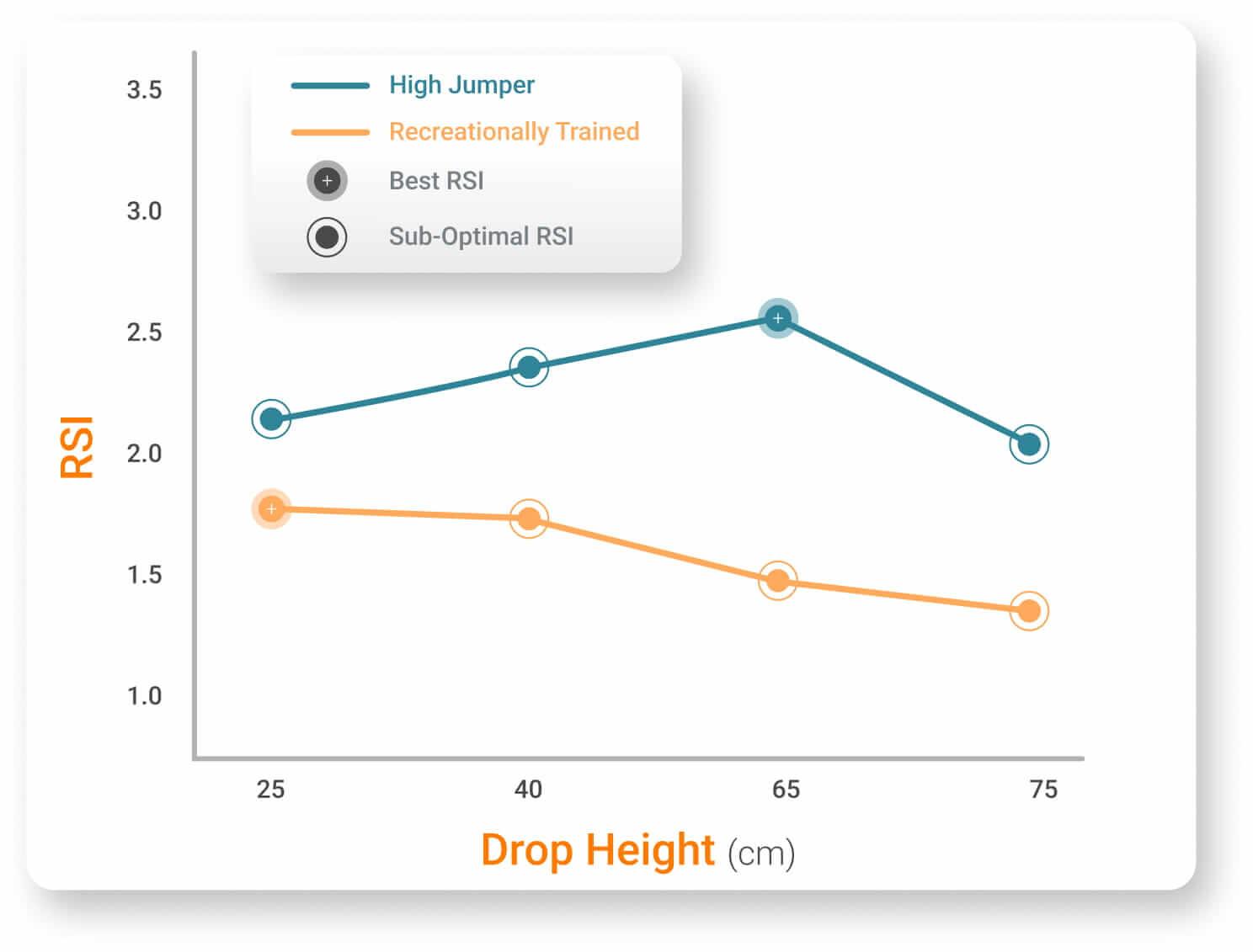
DJ profiles plotted for two different athletes, comparing their optimal drop heights.
Case Example 1
Athletes can produce similar jump heights in slower tasks like the CMJ while displaying very different levels of reactive strength in fast SSC tasks like the DJ. Comparing these tests side by side helps practitioners identify where an athlete is deficient, which enables more targeted training interventions.
|
CMJ Height |
CMJ Contraction Time |
DJ RSI |
DJ Contact Time | Analysis |
Training Emphasis | |
|
Athlete A | 0.48m | 0.810s | 2.31m/s | 0.192s | Relatively underdeveloped slow SSC ability |
|
| Athlete B | 0.47m | 0.770s | 1.69m/s | 0.237s |
Relatively underdeveloped reactive strength |
|
In this case, Athlete A demonstrates a substantially higher DJ RSI than Athlete B, despite near identical CMJ height and even a slightly longer CMJ contraction time. The constraints of the DJ fundamentally alter the neuromuscular demands of the task, enabling reactive strength to be isolated.
[Contraction time] in the CMJ…does not replicate the strict temporal and mechanical constraints of the DJ…
While contraction time can be quantified in the CMJ, it does not replicate the strict constraints of the DJ and therefore has limited explanatory value for DJ RSI outcomes.
Diagnosis and Training Intervention
Athlete A presents with well-developed reactive strength but comparatively limited slow SSC performance. Accordingly, training should retain exposure to reactive tasks while placing greater emphasis on unloaded and loaded ballistic tasks, with the primary instruction to maximize jump height. In addition, heavy strength training will demonstrate good transfer to slow SSC jump performance.
[Athlete A’s] training should retain exposure to reactive tasks while placing greater emphasis on unloaded and loaded ballistic tasks…
In contrast, Athlete B demonstrates the opposite profile, with adequate slow SSC strength but underdeveloped reactive strength. For this athlete, the priority shifts toward improving fast SSC function, with plyometric training prescribed under strict technical constraints that emphasize maximal rebound performance, specifically targeting high-jump outputs alongside minimal GCTs.
Case Example 2
In some cases, direct or surrogate measures of sport performance can be included alongside specific strength qualities. Here, two high jump athletes are assessed using their personal-best height and single-leg run-up vertical jump as direct and surrogate performance measures. These sit alongside reactive strength to provide context for strength diagnosis.
| High Jump Personal Best | Running Vertical Jump (Single Leg) | DJ RSI | Analysis | Training Emphasis | |
| Athlete A |
1.80m (very good) | 89cm (excellent) | 3.27m/s (excellent) |
| High jump technique |
| Athlete B | 1.92m (excellent) | 89cm (excellent) | 2.35m/s (average) |
| Physical qualities, notably reactive strength |
Diagnosis and Training Intervention
Athlete B is the better high jumper despite only average reactive strength, suggesting that performance is currently being supported more by technical proficiency than physical capacity. In this case, reactive strength is likely the limiting factor, and further improvement may depend on developing the ability to tolerate and redirect higher eccentric loads during the jump.
In [Athlete B], reactive strength is likely the limiting factor, and further improvement may depend on developing [that] ability…
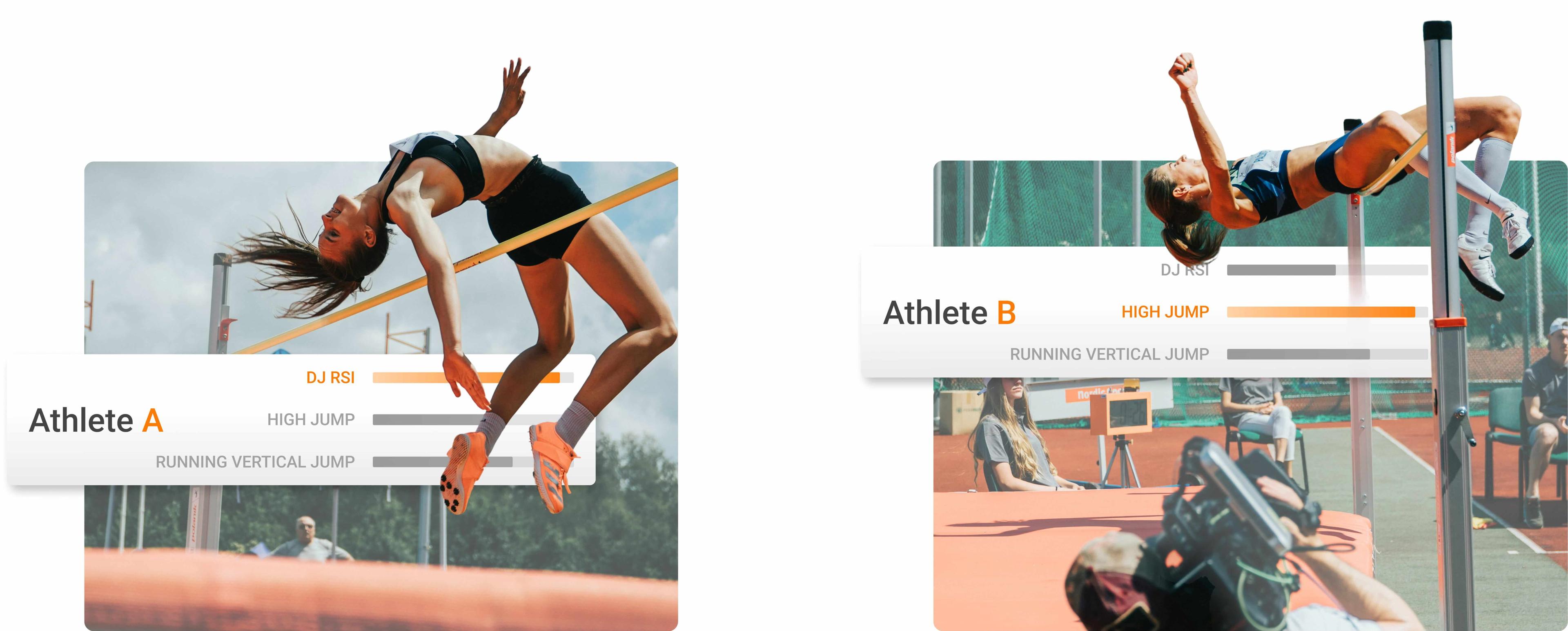
Two different high jump athletes with differing plyometric strengths and weaknesses.
In contrast, Athlete A demonstrates strong reactive strength and expresses it well in the running vertical jump, yet underperforms in the high jump. This suggests a limitation in technical execution rather than physical capacity. The priority should be refining high jump technique to better translate existing qualities into performance.
Measuring reactive strength helps [determine performance limitations]…guiding more targeted training decisions.
Measuring reactive strength helps practitioners identify whether performance is limited by physical capacity or skill execution, guiding more targeted training decisions.
Take Home Points
Reactive strength is the ability to tolerate high eccentric loads and redirect force rapidly within very short GCTs (under 250ms). It is a distinct neuromuscular quality with limited overlap with other strength expressions and therefore requires specific assessment and training.
It is most commonly assessed using rebound jumping tasks, such as DJs or hop tests, which measure RSI. For valid measurement, performers must minimize contact time while maximizing jump height, as prioritizing either in isolation alters task performance.
Training should reflect these constraints. Plyometric exercises performed under strict temporal demands are required, with limited transfer expected from general strength or slower ballistic tasks. Interpreting reactive strength alongside sport-specific performance measures further clarifies whether limitations are physical or technical, improving diagnostic precision.
If you would like to learn how ForceDecks can support reactive strength assessment, guide jump profiling and inform training decision-making, get in touch with our team.
References
- James, L. P., Talpey, S. W., Young, W. B., Geneau, M. C., Newton, R. U., & Gastin, P. B. (2023). Strength classification and diagnosis: Not all strength is created equal. Strength and Conditioning Journal, 45(3), 333–341. https://doi.org/10.1519/ssc.0000000000000744
