Understanding Velocity Zones: Applying velocity-based training to program design
Available in:
EN
Velocity-based training (VBT) uses movement velocity to prescribe, monitor and adjust training intensity. Because velocity decreases as load increases, it places resistance training on a continuum from slow, heavy exercise to fast, ballistic movement, with each velocity zone emphasizing a different adaptation.
Importantly, these zones should be viewed as practical guidelines rather than rigid physiological boundaries. The exact velocities associated with each zone vary by exercise and athlete. For example, Olympic lifts and lower-extremity resistance training typically require higher movement velocities than traditional strength or upper-body exercises because of their greater displacement.
…these [velocity] zones should be viewed as practical guidelines rather than rigid physiological boundaries.
For a broader introduction to VBT, explore our Velocity-Based Training 101 article:
Velocity zones provide an objective framework for applying training specificity, allowing practitioners to target the velocity ranges associated with the physical qualities they aim to develop. Mean velocity is the most commonly monitored metric because it is generally the most reliable for traditional resistance exercises. Olympic lifts and ballistic movements are exceptions, where peak velocity may better reflect performance.
The Five Velocity Zones
Every repetition falls somewhere on a spectrum from very heavy and very slow to very light and very fast. While this continuum is continuous, it is commonly divided into five practical training zones:
- Absolute strength
- Accelerative strength
- Strength-speed
- Speed-strength
- Starting strength
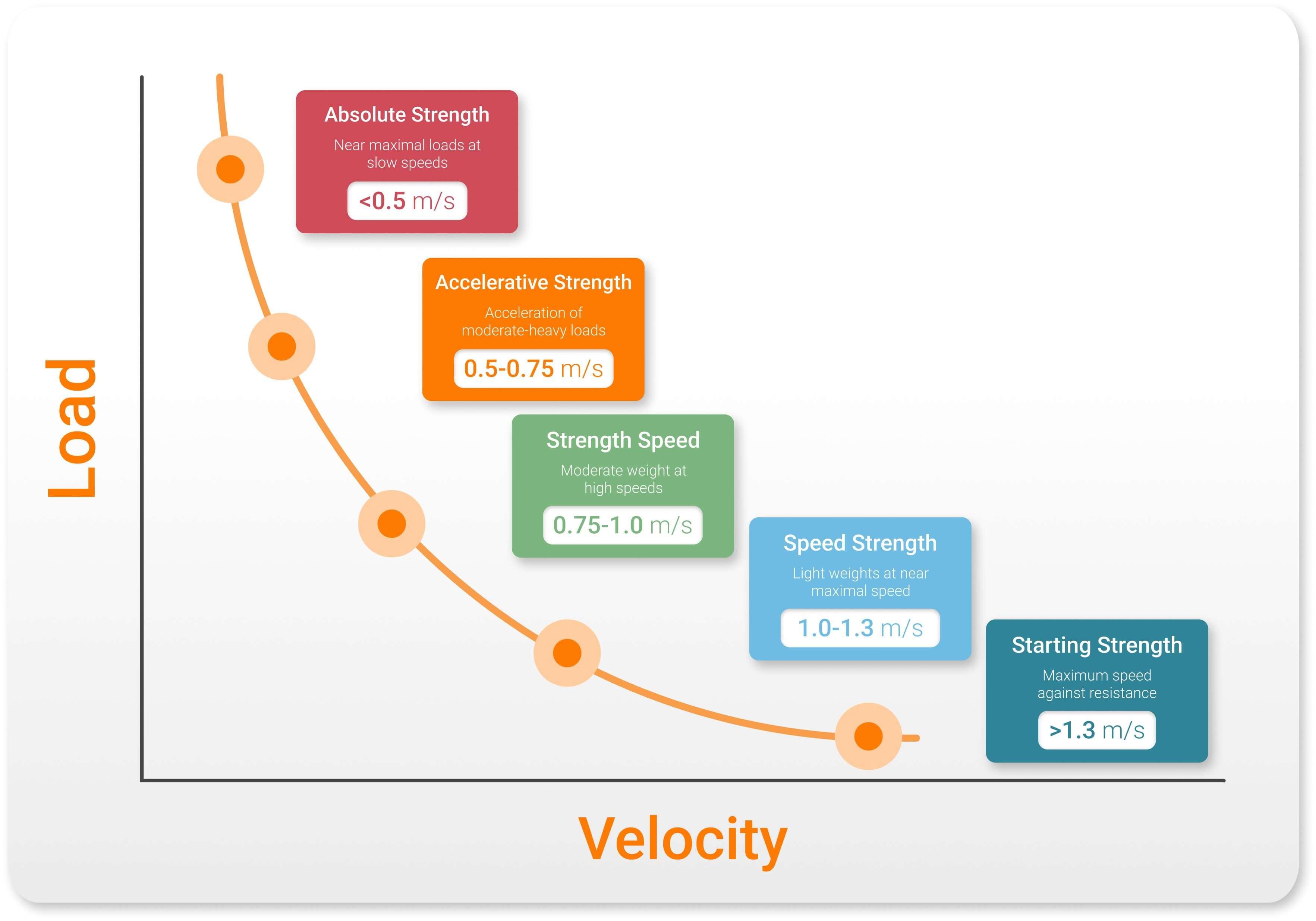
The five practical training zones across the force-velocity continuum.
Although presented separately, these qualities overlap considerably. Most sporting actions involve multiple zones throughout the movement, with different phases emphasizing different physical qualities.
Although presented separately, these qualities overlap considerably. Most sporting actions involve multiple zones throughout the movement, with different phases emphasizing different physical qualities.
Absolute Strength
Training at 80-100% one-repetition maximum (1RM) (typically <0.50m/s mean velocity) targets the ability to produce maximal force against very heavy loads. As load increases, movement velocity naturally decreases, with maximal squat attempts commonly occurring around 0.30m/s and maximal bench press attempts around 0.15m/s (González-Badillo et al., 2010). Common exercises include:
- Back squat
- Front squat
- Deadlift
- Bench press
This quality underpins performance in activities where success depends on producing high levels of force rather than moving quickly, such as rugby scrums, American football line play, wrestling clinches and powerlifting. Prioritize this zone when athletes need to maximize force production against heavy resistance or opponents.
Accelerative Strength
Training at 60-80% 1RM (typically 0.50-0.75m/s mean velocity) targets the ability to produce high forces while moving relatively heavy loads as quickly as possible. This zone bridges maximal strength and higher-velocity performance, emphasizing rapid force production without sacrificing load. Common exercises include:
- Squat
- Trap bar deadlift
- Hip thrust
- Split squat
- Bench press
This quality is critical during the early stages of acceleration, such as the first few skating strides in ice hockey, the initial push from the blocks in a track sprint or the opening pedal strokes in track cycling. Practitioners may prioritize this zone to improve acceleration and early force production from a static start.
Strength-Speed
Training at 40-60% 1RM (typically 0.75-1.00m/s mean velocity) targets the ability to produce substantial force at high movement velocities. This zone balances force and speed, making it highly relevant for explosive movements across many field and court sports. Common exercises include:
- Moderate load squat jump
- Split squat
- Trap bar jump
- Bench press
- Deadlift
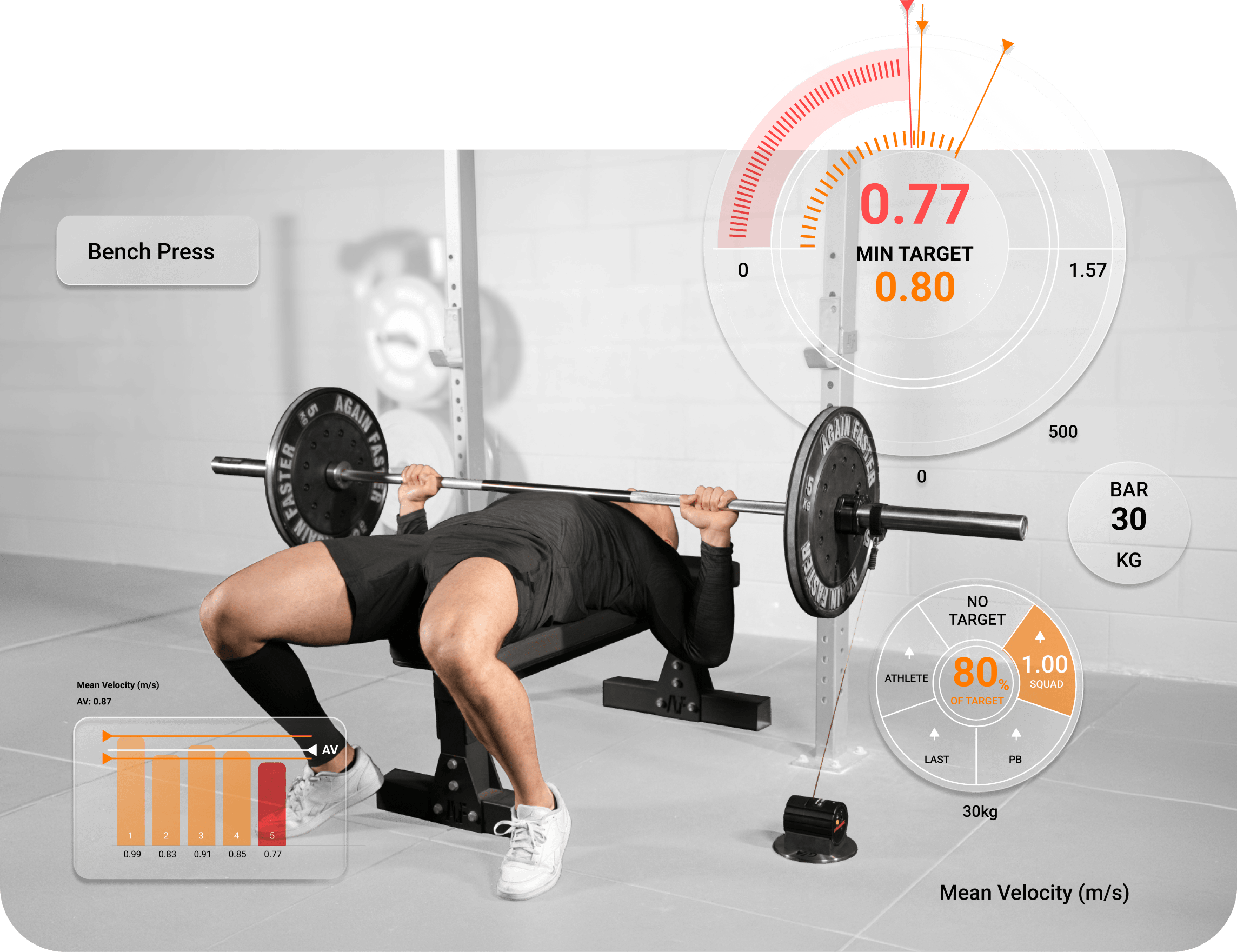
GymAware provides real-time mean velocity feedback during a bench press set, allowing practitioners to compare performance data with a prescribed velocity target.
This quality is often associated with traditional power training and contributes to change of direction and explosive actions such as driving past a defender in basketball, accelerating into space in soccer or pushing laterally from a split step in tennis. Practitioners can prioritize this zone when the goal is to improve explosive performance qualities that depend on both load and movement speed.
Speed-Strength
Training at 20-40% 1RM (typically 1.00-1.30m/s mean velocity) emphasizes high movement velocities while maintaining enough resistance to keep movement velocity below maximal speed. Common exercises include:
- Lightly loaded squat jump
- Olympic lift derivative (e.g., clean pull)
- Loaded jump
- Medicine ball throw
- Banded exercise
This quality supports explosive actions such as the late acceleration phase of a sprint or a volleyball approach jump, where force must be produced rapidly at high movement velocities. Practitioners can prioritize this zone when working with athletes who need to improve explosive speed while retaining a modest strength stimulus.
Starting Strength
Training with bodyweight to very light loads (typically >1.30m/s mean velocity) targets the ability to move light loads at maximal velocities. Common exercises include:
- Squat jump
- Standing vertical jump
- Reactive plyometric exercise
- Light Olympic lift derivative
- Medicine ball throw
This quality underpins explosive actions such as maximal-velocity sprinting, rebounding in basketball or running a route in American football. Practitioners can prioritize this zone when aiming to improve maximal rate of force development and explosive strength qualities.
Strength-Speed vs. Speed-Strength
Although these terms are often used interchangeably, they represent different regions of the force-velocity continuum. Strength-speed emphasizes producing high forces with moderate loads, whereas speed-strength shifts the emphasis toward higher movement velocities with lighter loads.
Although [strength-speed and speed-strength] are often used interchangeably…distinguishing between them allows practitioners to target adaptations with greater precision.
Peak power is commonly produced within these two zones, which is why they are often grouped as “power training.” However, distinguishing between them allows practitioners to target adaptations with greater precision.
Applying Velocity Zones to Program Design
Velocity zones should not be viewed as isolated categories. Most sporting movements span multiple regions of the force-velocity continuum. For example, a clean progresses from high-force production during the initial pull toward higher movement velocities during the second pull, sprint acceleration transitions from force-dominant early steps to increasingly velocity-dominant mechanics and jumping requires both force production and movement velocity throughout takeoff.
Traditional resistance training typically uses a percentage of 1RM to prescribe intensity, assuming maximal strength remains constant. In reality, daily fluctuations in fatigue, recovery, travel, sleep and training load mean the same percentage may represent a different relative intensity from one session to the next.
Velocity provides an objective alternative. When an athlete performs with maximal intent, movement velocity is indicative of relative intensity. Therefore, practitioners can prescribe target velocities and adjust load in real time to maintain the intended training stimulus. This allows training intensity to reflect the athlete’s readiness on the day rather than relying solely on previously tested 1RM values.
Velocity provides an objective alternative …[allowing] training intensity to reflect the athlete’s readiness on the day rather than relying solely on previously tested 1RM values.
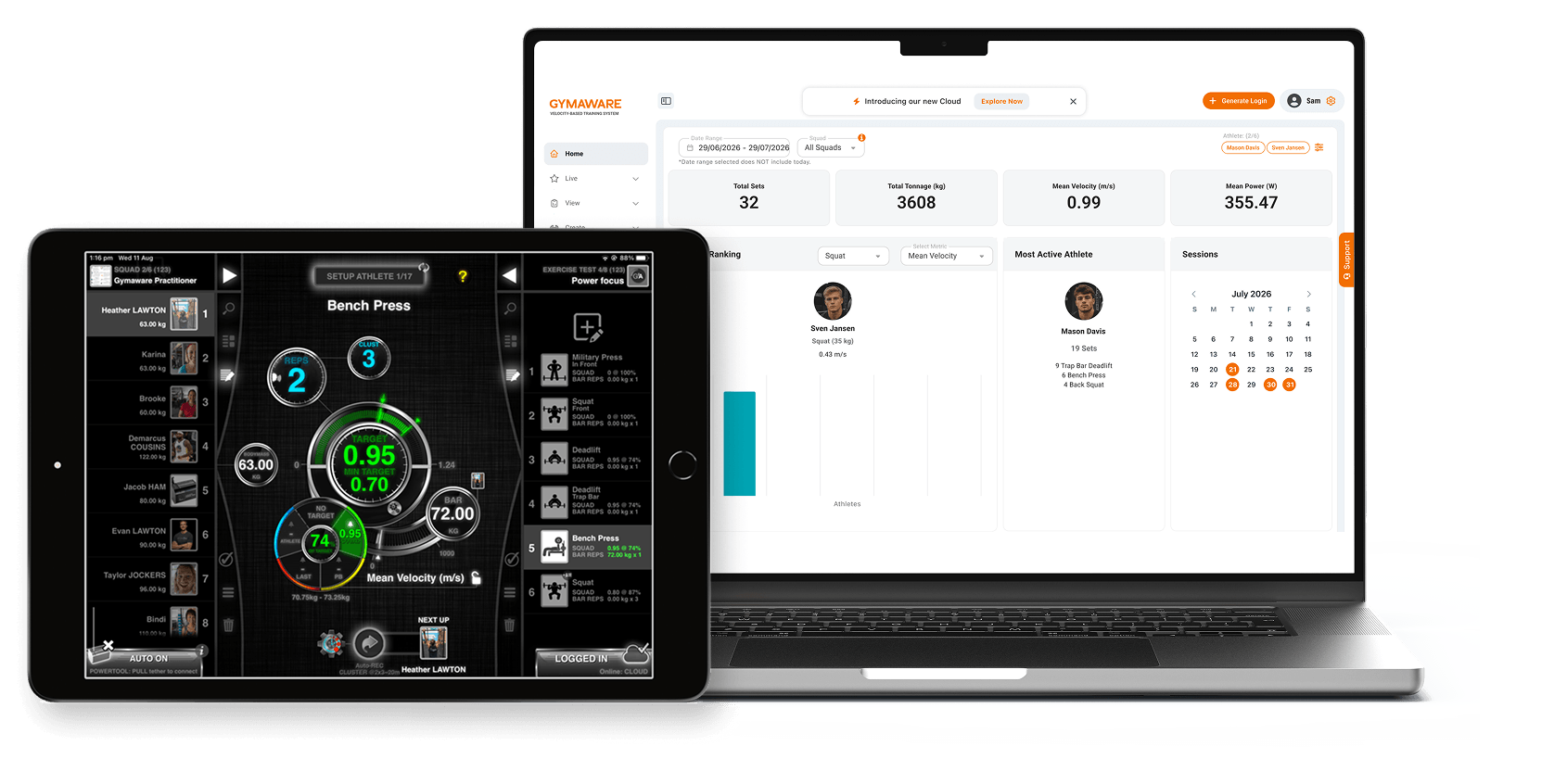
GymAware combines real-time velocity feedback with cloud-based training data to support programming and monitoring.
Velocity, Specificity and Individualization
Velocity zones should support decision-making rather than replace coaching judgment.
Individual athletes have different force-velocity profiles, exercise techniques and training histories. As a result, the exact velocity associated with a given adaptation will differ between athletes and across exercises. Rather than chasing a specific velocity value, the objective of VBT is to ensure training consistently targets the physical quality most relevant to the athlete.
Rather than chasing a specific velocity value, the objective of VBT is to ensure training consistently targets the physical quality most relevant to the athlete.
When combined with reliable measurement technology, velocity provides an objective way to individualize resistance training, verify training intent and monitor adaptation over time. By aligning exercise selection, loading and movement velocity with the desired physical outcome, practitioners can apply specificity more consistently and make better-informed programming decisions.
If you are interested in using velocity zones to individualize loading and make more informed program design decisions, explore GymAware or get in touch with our team.
References
- González-Badillo, J. J., & Sánchez-Medina, L. (2010). Movement velocity as a measure of loading intensity in resistance training. International Journal of Sports Medicine, 31(5), 347–352. https://doi.org/10.1055/s-0030-1248333
