Sean Baker: Why I moved from 45° to 0° hip adduction and abduction testing
Available in:
EN
In high-performance sport, testing protocols are commonly integrated as long-standing components of a larger testing battery. Once a test is proven reliable, familiar to the athlete and supported by research, practitioners rarely question its utility.
Once a test is proven reliable, familiar to the athlete and supported by research, practitioners rarely question its utility.
As a practitioner, I tested hip adduction and abduction strength at 45° for these exact reasons. However, established practices do not always equate to best practices in sport.
The long-lever hip adduction and abduction at 0° with ForceFrame has since become my preferred assessment of hip strength and performance. Testing at 45° of hip flexion is still used on occasion, but this change in test prioritization reflects the current values I have established in my isometric testing protocols:
- Standardization
- Simplicity
- Scalability
- Alignment with physical qualities in sport
For more insight into how I use hip strength testing alongside other assessments to monitor athlete performance, explore this article:

Reducing Subjectivity in the Testing Position
One of my primary considerations with 45° testing was how consistently the position could be reproduced. If a protocol specifies 45°, practitioners need confidence that the athlete is actually positioned at this exact angle. In practice, practitioners may estimate knee and hip positions rather than measure them directly, introducing potential variation between practitioners and testing sessions.
In practice, practitioners may estimate knee and hip positions rather than measure them directly, introducing potential variation between practitioners and testing sessions.
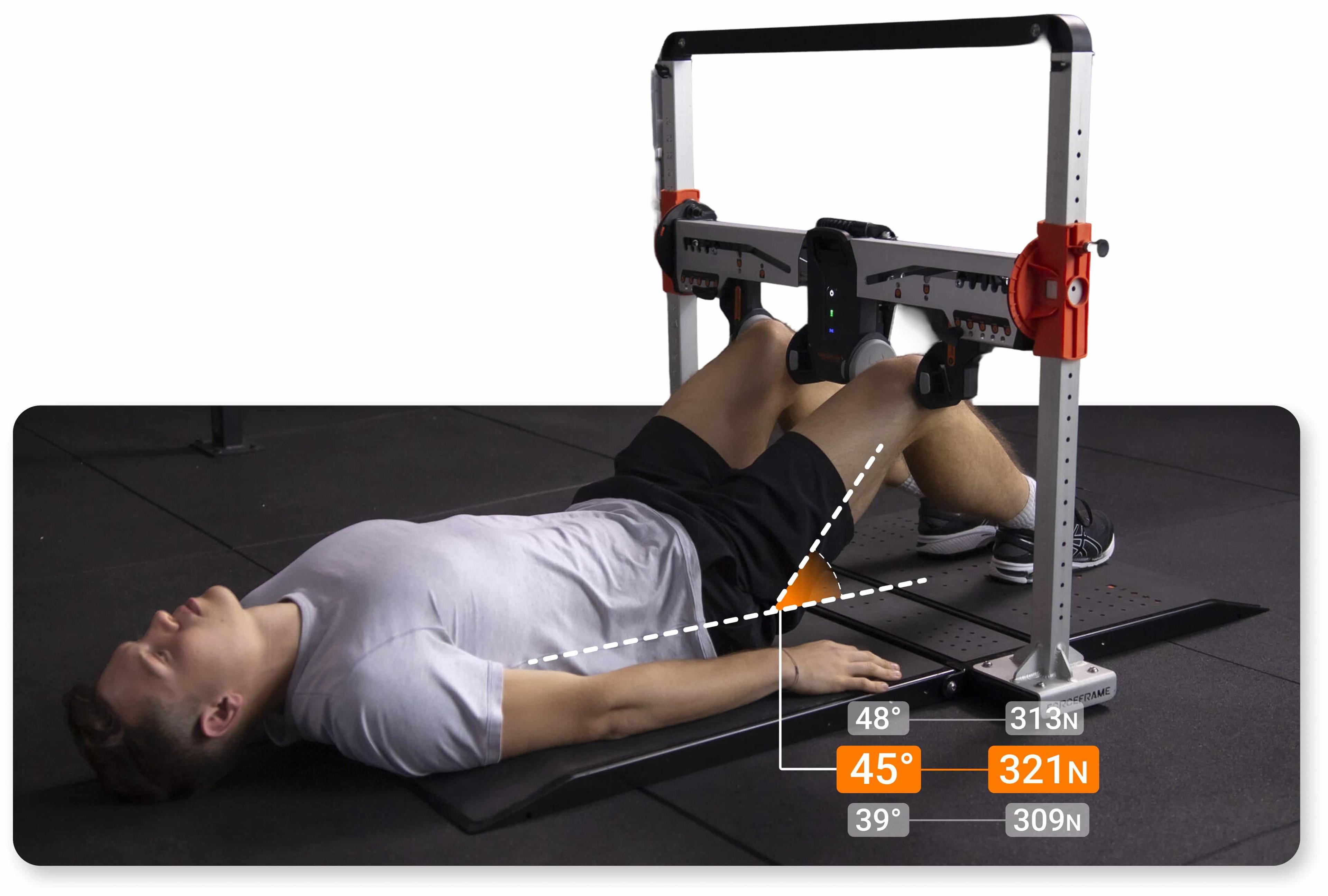
This became particularly relevant early on at Lacrosse Australia, where athletes are often assessed by various practitioners across different states and environments. After seeing this firsthand, we transitioned to hip adduction and abduction testing at 0° as the default test to ensure consistency in execution and performance. Elite sport also involves frequent changes in setting, schedules and practitioner demands, making testing one of many competing priorities.
This introduced another way of thinking about reliability. A protocol may demonstrate strong reliability under controlled research conditions, but practitioners also need to consider how reliably they can implement it in their own environment.
At 0°, the setup is straightforward: establish a consistent straight-leg position, adjust ForceFrame and test. This requires less positional interpretation, making the protocol easier to reproduce across practitioners and locations.
Limiting Opportunities for Compensation
Maximal testing introduces another consideration: athletes are very good at finding ways to produce force. During 45° testing, some athletes would subtly change pelvic position or lift their hips off the testing surface during maximal efforts. These movements were often small but raised questions about whether athletes reproduced the same strategy across testing sessions.
Changes in position may also alter muscular contribution to the task, particularly given the different functions of the adductor group across hip positions.
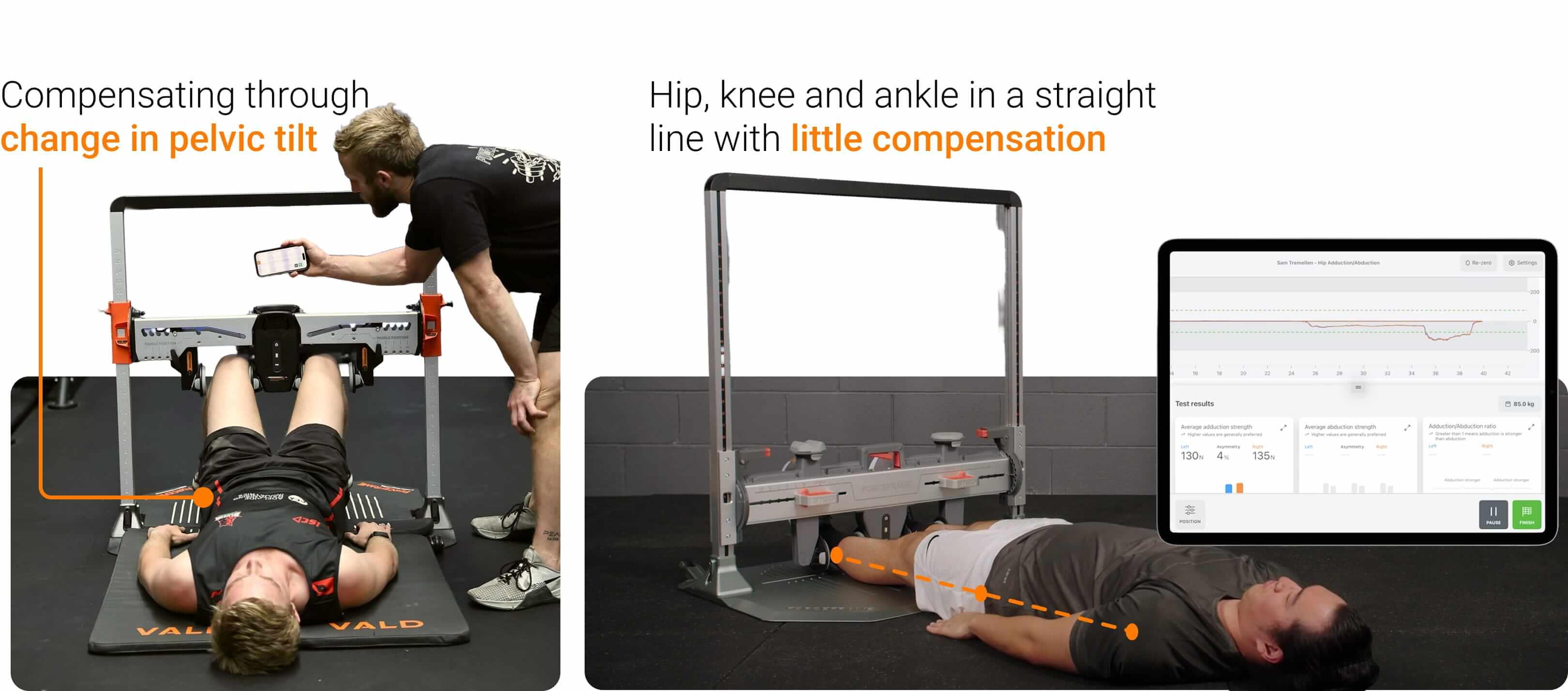
Moving to a long-lever position does not eliminate compensation or isolate the adductors. However, it simplifies the task and reduces opportunities for athletes to change position while pursuing a higher result.
Moving to a long-lever position does not eliminate compensation…[but] it simplifies the task and reduces opportunities for athletes to change position…
Making Testing Scalable Across a Squad
Time is an important consideration when selecting testing protocols. Testing one athlete under tightly controlled conditions is relatively straightforward, whereas testing 20, 25 or 30 athletes within a limited training window introduces different constraints.
Maintaining an accurate 45° position requires practitioners to establish and potentially adjust that position for each athlete. Across a squad and over repeated testing sessions throughout a season, those small adjustments accumulate.
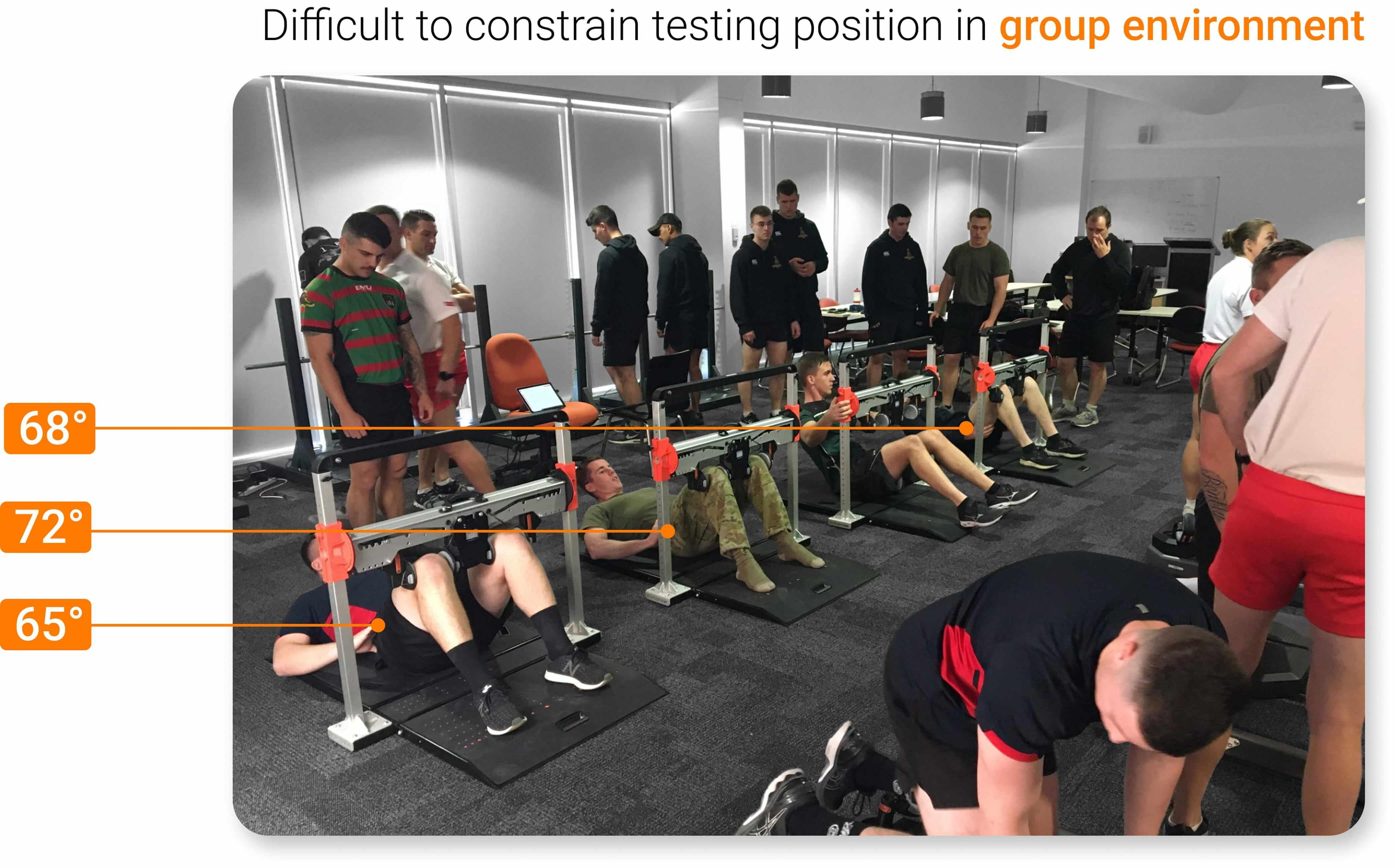
At 0°, relatively little positional adjustment is required between athletes. With the athlete in position, ForceFrame is adjusted appropriately and testing can begin. A useful monitoring protocol therefore requires more than demonstrated reliability. It needs to be reproducible and practical enough to implement consistently within the limitations of the testing environment.
A useful monitoring protocol therefore…needs to be reproducible and practical enough to implement consistently…
Connecting Monitoring with Rehabilitation
The long-lever position also aligns with how we progressively load the adductors during rehabilitation. Following an adductor injury or during the management of athletic groin pain, athletes are progressively exposed to greater adductor demands, and long-lever strength becomes increasingly relevant during later-stage rehabilitation and assessment.
Testing at 0° provides a baseline measure of long-lever capacity while an athlete is healthy, training fully and performing. If the athlete subsequently enters rehabilitation, current results can be compared with their pre-injury baseline and considered alongside limb symmetry, population reference data and other rehabilitation criteria.
…long-lever strength becomes increasingly relevant during later-stage rehabilitation and assessment.
Using a consistent position across monitoring and rehabilitation creates a clearer connection between baseline testing, rehabilitation progression and return-to-performance decision-making.
To learn more about assessment of hip and groin performance and health, check out the Practitioner’s Guide to Hip and Groin:
Testing Should Answer a Question
The principles behind protocol selection extend beyond hip strength testing. Access to objective data continues to grow, but established assessments should still have a clear purpose within a testing battery. Practitioners should understand what physical quality is being assessed, whether the protocol can be reproduced consistently and efficiently and how the resulting data informs training, rehabilitation or return-to-performance decisions.
ForceFrame supports hip adduction and abduction testing across multiple positions, allowing practitioners to select and standardize protocols according to their environment and testing objectives. In this case, moving from 45° to 0° provided a simpler and more scalable protocol while creating greater alignment between routine monitoring and rehabilitation.
Normative data adds further context to these results, but the value of any assessment ultimately depends on how consistently it can be implemented and how the information is used to inform practice.
To learn how ForceFrame can help you standardize hip adduction and abduction testing to support monitoring and rehabilitation across your squad, get in touch with our team.
