
Logan Daughtry is an assistant professor at Catawba College and a former Division I strength and conditioning coach who has worked with students and athletes for over 10 years.
Logan DaughtryEdD, CSCS*D
Available in:
EN
Logan Daughtry is an assistant professor at Catawba College and a former Division I strength and conditioning coach who has worked with students and athletes for over 10 years.
Logan Daughtry is an assistant professor at Catawba College and a former Division I strength and conditioning coach who has worked with students and athletes for over 10 years.
Velocity-based training (VBT) uses movement velocity to prescribe, monitor and adjust training components. Rather than treating weight as the only indicator of training intensity, VBT provides an objective measure of how quickly an athlete moves a given load and how that performance changes across repetitions, sets and training phases.
For performance coaches, setup, device placement, exercise selection, data quality and coaching decisions all determine whether velocity data is useful. VBT systems should measure variables relevant to the training goal, produce repeatable data and capture relevant trends in the weight room.
Effective velocity-based training starts with clearly defined training goals and a measurement strategy that supports them. As with any aspect of resistance training, VBT system selection should be guided by athlete needs, practitioner priorities and the intended application.
As with any aspect of resistance training, VBT system selection should be guided by athlete needs, practitioner priorities and the intended application.
The practical value of a VBT system depends on several factors, including its validity and reliability, setup consistency, efficiency in transitioning between athletes, quality of real-time feedback and organization of collected data.
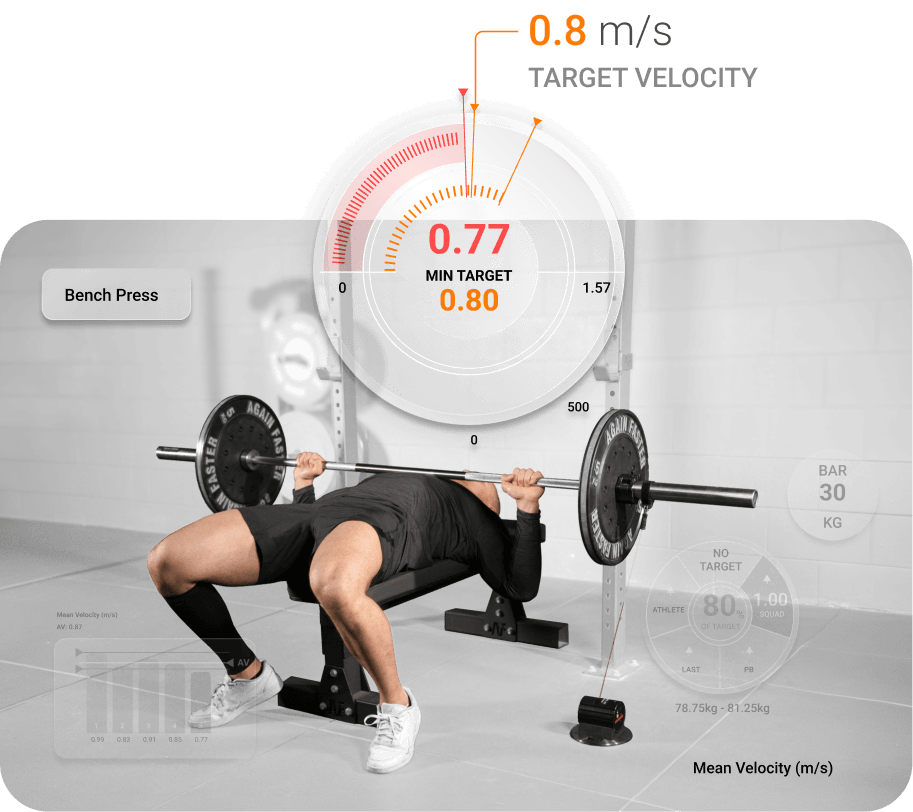
Beyond measurement accuracy, the system also needs to integrate efficiently into existing training workflows without disrupting session delivery. A well-designed VBT system should support both immediate load adjustments and longitudinal monitoring, allowing practitioners to translate velocity data into informed programming decisions.
VBT systems have different technology options for measuring movement velocity. Camera-based systems use motion capture software to measure bar or athlete movement across video frames over time. Inertial measurement units (IMUs) use onboard accelerometers and gyroscopes to track acceleration and rotational movement, giving an estimate of velocity.
Linear position transducers (LPTs) measure displacement over time using a tether attached to the bar or implement, providing direct velocity measurements. Practitioners can compare each system’s capabilities, measurement method and potential limitations before selecting the device that best fits their training environment, particularly when working with large squads (Balsalobre-Fernández & Torres-Ronda, 2021).
| Consideration | LPT | IMU | Camera-Based |
| Established Validity and Reliability* | ✅ | ✅ | ✅ |
| Simple Weight Room Workflow | ✅ | ✅ | ❌ |
| Suitable for Lab and Weight Room Use | ✅ | ✅ | ❌ |
| Portable | ✅ | ✅ | ❌ |
| Multiplanar Movement Tracking* | ❌ | ✅ | ✅ |
| Low Setup and Calibration Demands* | ✅ | ❌ | ❌ |
| Validated X-Axis Correction* | ✅ | ❌ | ❌ |
| Low Angle Sensitivity* | ✅ | ❌ | ❌ |
|
Key Takeaway: LPT systems generally meet the majority of professional needs, depending on the platform, while IMU and camera-based systems are better suited for untethered movements (e.g., running and rotation). | |||
*Comparison is based on commonly available systems. Capabilities, performance and features may vary between specific devices and software platforms.
VBT devices do not all report velocity in the same way. When reviewing VBT devices, practitioners are often encouraged to understand which measurements are available and how they align with the intended training goal. VBT systems, such as GymAware, should provide enough information to understand the full lift rather than relying on a single velocity value. Therefore, metrics and insights that practitioners may look for in a VBT system might include:
A system used across multiple training populations should support a range of lifting outcomes to meet different athletic demands and training goals.
A system used across multiple training populations should support a range of lifting outcomes to meet different athletic demands and training goals.
LPT systems, such as GymAware RS, are commonly preferred due to their reliability and ease of use. Research assessing the GymAware LPT model across multiple common resistance exercises found generally strong agreement for most measured variables with low-to-moderate typical error (Dorrell et al., 2019).
GymAware Cloud allows practitioners to visualize load-velocity relationships and analyze individual repetition data in greater detail. When the LPT cannot be positioned directly beneath the bar, GymAware RS automatically applies X-axis correction to account for horizontal displacement, helping maintain measurement consistency and reduce variability between testers.
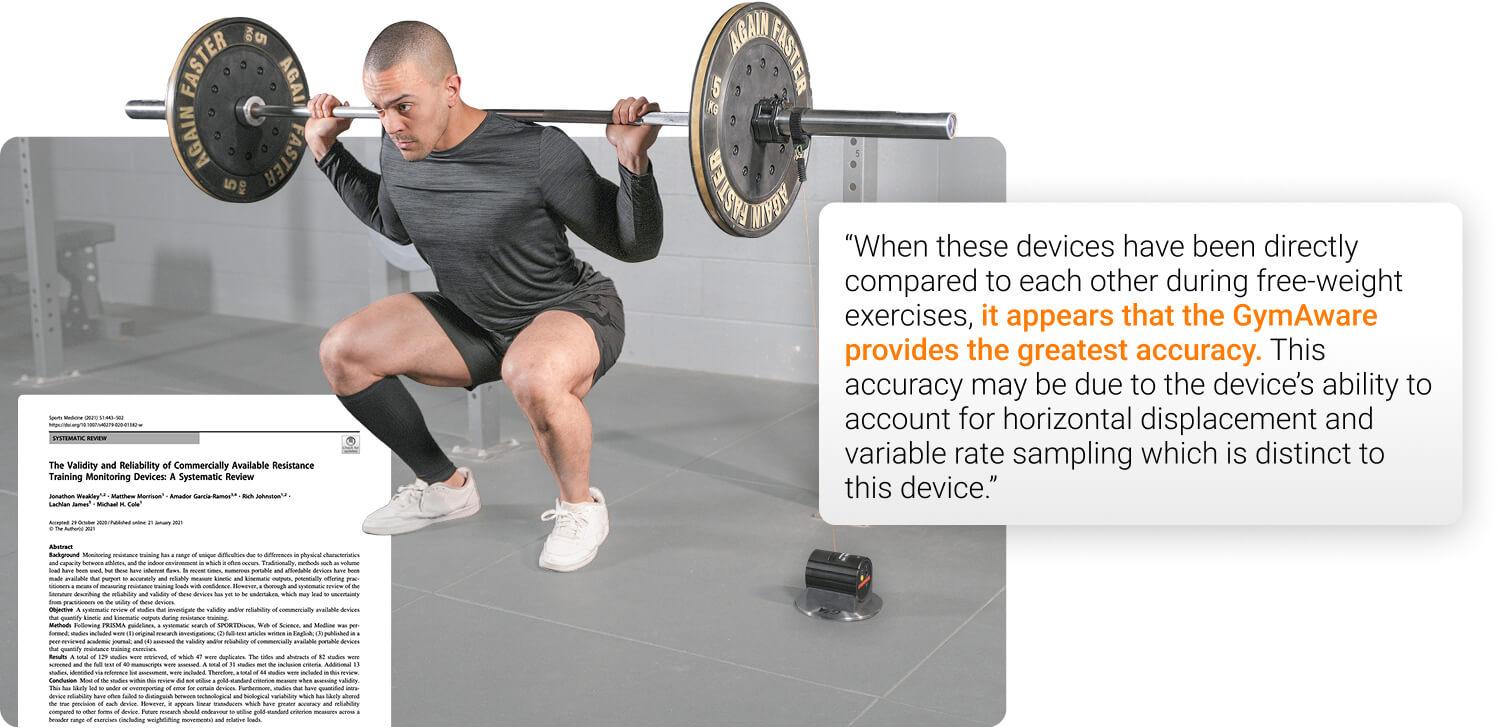
GymAware FLEX uses laser-based optical measurement with a reflective mat and provides many of the same output metrics as the RS model. The marked mat provides a repeatable placement reference, while the associated platform can display velocity, bar-path information and session data for later review. The choice between an LPT and an optical system should be based on exercise selection and training needs.
Measurement quality only adds value if the system can be used consistently within the training workflow. In team settings, practical considerations for maintaining training flow include:
Measurement quality only adds value if the system can be used consistently within the training workflow.
Live feedback can support training intention and set-by-set adjustments. Consistent feedback and athlete profile selection can also increase engagement with the prescribed training intent.
Many VBT systems use a tablet-based application, allowing the tablet to be mounted to the rack or machine. If the system requires several manual adjustments between sets, it will be impractical to use in a team setting. To maintain training flow, the platform should support both individual and team-based use.
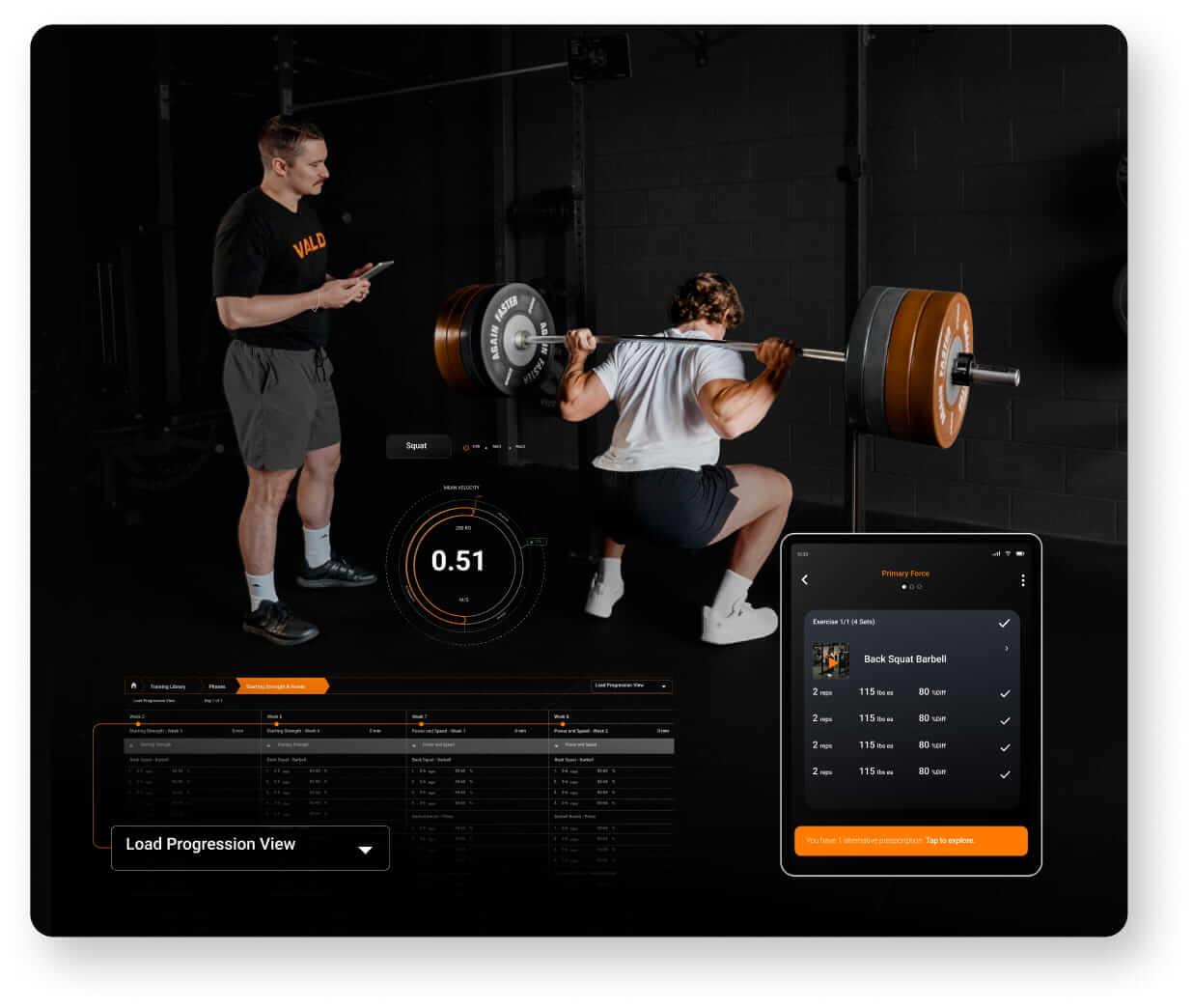
GymAware allows practitioners to share training prescriptions and review performance data with their athletes.
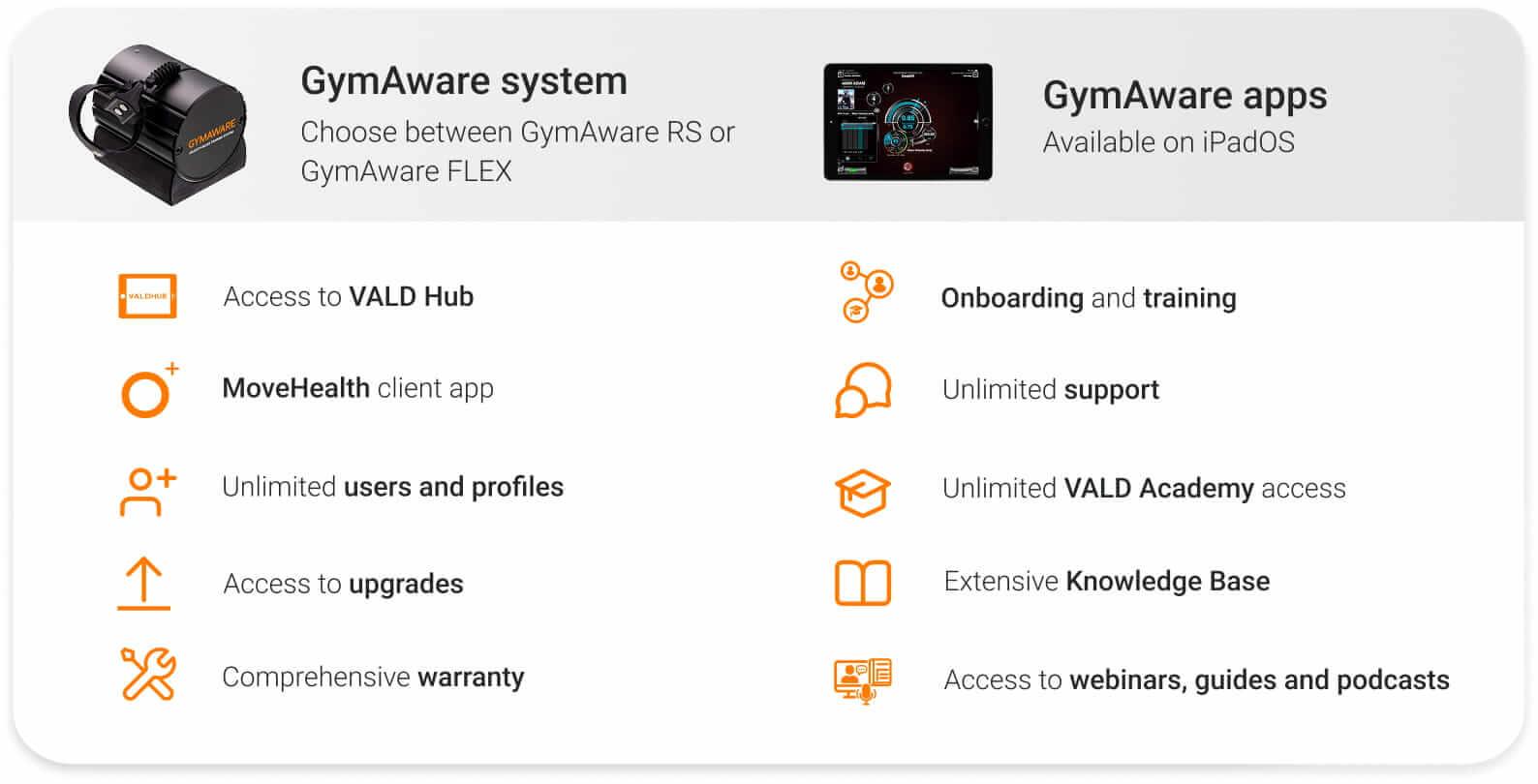
To get the most out of a VBT system, the measurement hardware should be supported by a platform that can organize athlete and team data and provide the resources needed to use the system correctly. To support ongoing data management and monitoring, practitioners should look for features and resources such as:
These features become increasingly important as VBT expands across larger groups and longer training periods. A supporting platform can reduce administrative demands and centralize the tools practitioners need. In practice, GymAware RS connects with VALD Hub, centralizes athlete and team data, provides technical support and offers access to VALD Academy and Knowledge Base resources.
Questions like “What do I do with this data?” or “How should this influence training?” will inevitably come up. The supporting platform should provide resources that help practitioners answer these questions and interpret the data effectively. When choosing a VBT system, features beyond velocity data should be considered for ongoing use.
The supporting platform should provide resources that help practitioners answer these questions and interpret the data effectively.
Choosing a VBT system should begin with the demands of the training environment. Practitioners should consider the velocity measurements needed, the suitability of the measurement technology for the exercises being monitored, the device’s validity and reliability and workflow efficiency.
If you would like to explore which GymAware system best suits your training environment and goals, get in touch with our team.

Copyright © 2026 VALD Performance
.
All Rights Reserved |
Privacy Policy