Understanding the Eccentric Utilization Ratio
Available in:
EN
Defining and Contextualizing the Eccentric Utilization Ratio
The eccentric utilization ratio (EUR) is a combined metric used in sports performance to evaluate how effectively an athlete uses a countermovement (or eccentric phase) to enhance lower-extremity power. The EUR does so by comparing jump height between a countermovement jump (CMJ) and squat jump (SJ) (McGuigan et al., 2006).

Commonly, CMJ jump heights are greater than SJ jump heights. This is often attributed to the stretch-shortening cycle (SSC), where rapid eccentric loads can deform tendons to store and release elastic energy. However, the SSC may not be the only factor involved in differentiating the CMJ and SJ.
…the SSC may not be the only factor involved in differentiating the CMJ and SJ.
The Mechanical Drivers of Jumping Performance
The SSC describes the interaction between rapid eccentric muscle actions and their subsequent concentric contraction, where elastic energy is stored as rapid tendon strain (i.e., “stretch”), and the subsequent recoil of this strain contributes to increased force and power during ballistic tasks (Komi, 2000).
The CMJ incorporates this mechanism through its countermovement, whereas the SJ has minimal SSC contribution because it starts from a static squat position, making the comparison between the two a useful proxy for SSC contribution.
However, improvements in CMJ performance are not explained by SSC behavior alone. Large deceleration forces during the eccentric phase of a CMJ have been shown to increase concentric force and power output, ultimately improving jump height (Bobbert et al., 1996; Kozinc et al., 2024).
Eccentric muscle actions are capable of producing and tolerating higher forces than concentric actions (Holmes, 2006). During a CMJ, the downward phase generates momentum that must be rapidly decelerated. This braking action elevates force levels at the transition into the concentric phase, effectively increasing the starting point for concentric force production. This results in a greater net concentric impulse, which is a primary determinant of jump height.
[The] braking action [in a CMJ] elevates force levels at the transition into the concentric phase, effectively increasing the starting point for concentric force production.
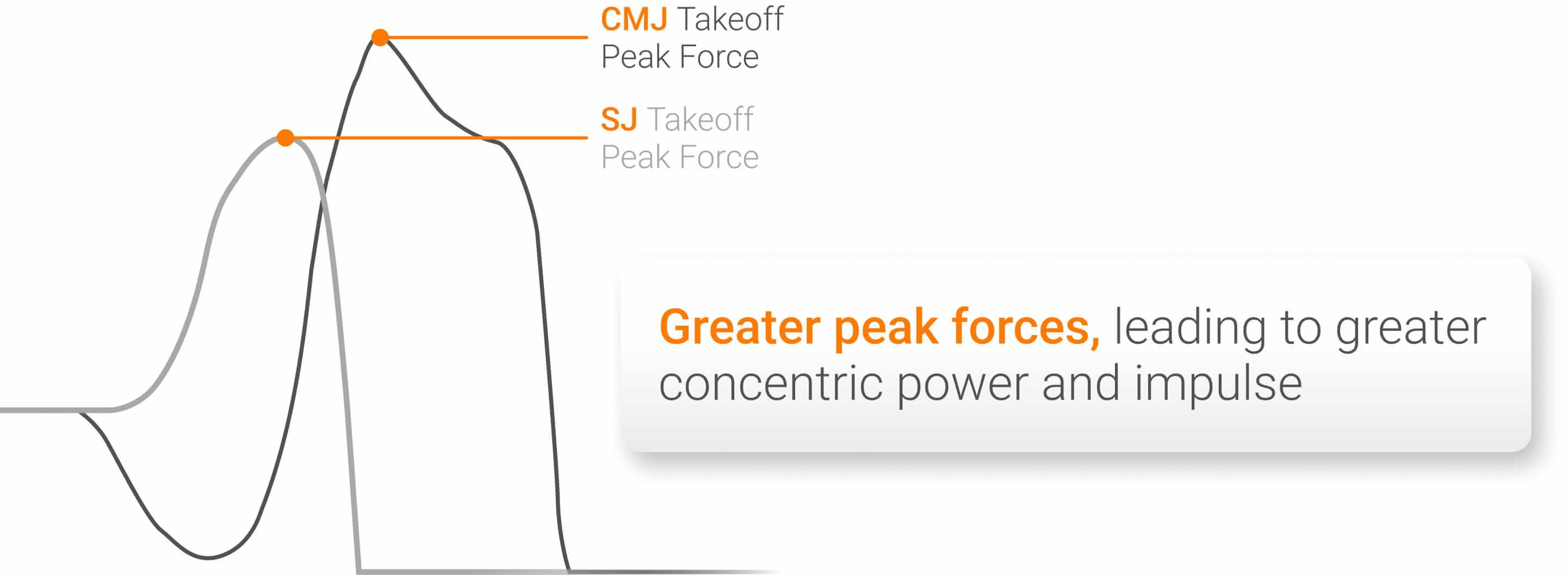
Together, SSC behavior and eccentric force amplification represent the primary mechanisms underpinning differences captured by the EUR.
Calculating and Interpreting EUR
In current coaching paradigms, the EUR is often applied using fixed thresholds and simple training rules. For example, an athlete with an EUR greater than 1.1 may be labeled as having strong eccentric utilization and directed toward strength-focused training, but these interpretations should be made cautiously, as ratio cutoffs alone rarely account for the athlete’s sport, position, goals, performance level or injury history.
…[thresholds] should be [applied] cautiously, as ratio cutoffs alone rarely account for the athlete’s sport, position, goals, performance level or injury history.
EUR should also be interpreted within the context of absolute performance. Two athletes may display similar EURs while possessing vastly different performance capacities, as shown below.
| CMJ Jump Height | SJ Jump Height | EUR | |
| Athlete A | 50cm | 43cm | 1.16 |
| Athlete B | 20cm | 17cm | 1.18 |
Despite nearly identical EUR values, these two athletes are clearly not the same. Athlete A demonstrates significantly greater jump heights in both the CMJ and SJ than Athlete B, meaning any training decision based solely on EUR would be insufficiently informed.
Based on these significant differences, visualizing EUR components in graphs such as Quadrant Charts may help further contextualize which athletes require specific training interventions. These charts can be created in VALD Hub on the Dashboards page.
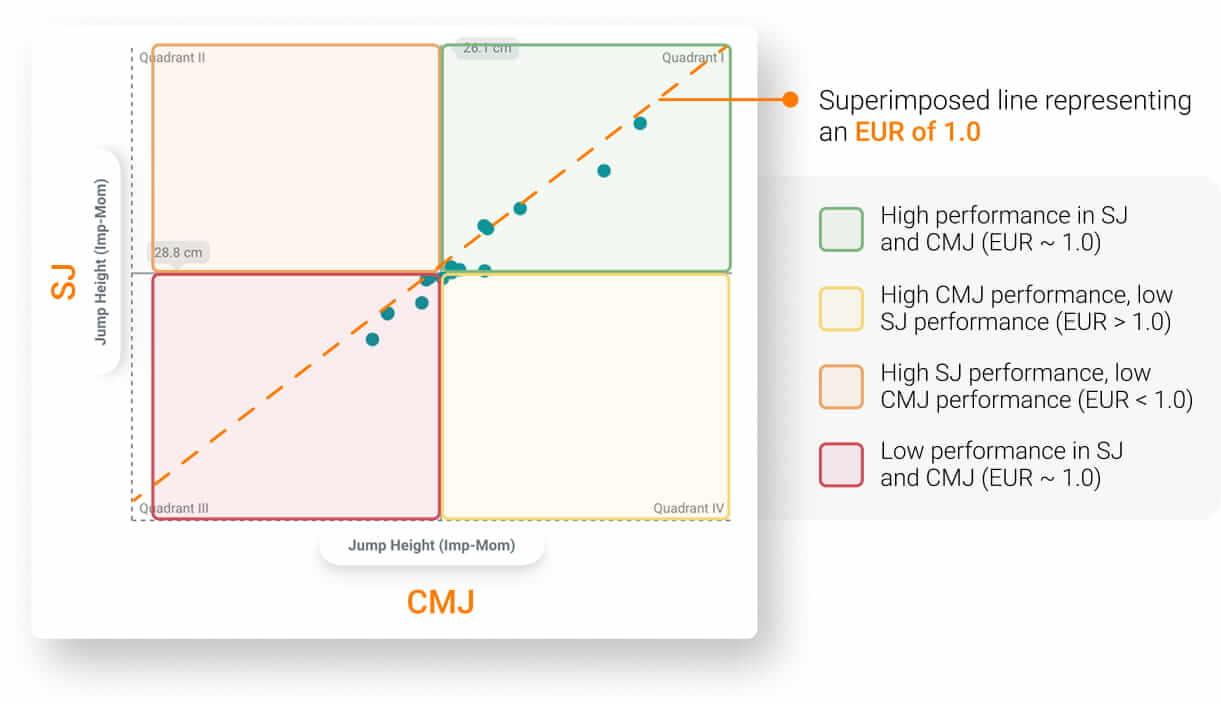
Low EUR values are often used to justify additional plyometric training, but this interpretation lacks context without considering absolute performance. An athlete may fall within an expected, or even “elite,” EUR range while still producing low jump outputs, creating the appearance of a “good” ratio despite limited underlying capacity.
Low EUR values are often used to justify additional plyometric training, but this…lacks context without considering absolute performance.
For this reason, EUR is more useful when interpreted alongside its individual components rather than in isolation. Assessing CMJ and SJ performance together allows practitioners to determine whether limitations are driven by overall force and power production, SSC utilization or a combination of both.
EUR Across Different Populations
EUR values vary considerably across training status and population characteristics. Some athletes, particularly those in sports emphasizing SSC function such as sprinting and jumping events, typically display elevated EUR values greater than 1.0 (McGuigan et al., 2006). Some less developed athletes, or those with differing sport demands, may present slightly lower values, closer to 0.9 or greater.
EUR can vary across levels of play, sports and positions. Data from VALD’s Data Lakehouse and the 2024/25 NFL and NCAA Football Normative Data Report indicate that while median EUR values may be higher in lower-performing populations (e.g., NCAA football), NFL athletes typically demonstrate superior absolute CMJ and SJ performance.
| NFL | Percentiles | ||||
| 10th | 25th | 50th | 75th | 99th | |
| CMJ Jump Height | 31.0cm | 36.3cm | 42.5cm | 49.1cm | 54.4cm |
| SJ Jump Height | 28.5cm | 33.3cm | 39.6cm | 45.8cm | 51.5cm |
| EUR | 0.92 | 1.00 | 1.07 | 1.16 | 1.26 |
| NCAA | Percentiles | ||||
| 10th | 25th | 50th | 75th | 99th | |
| CMJ Jump Height | 30.8cm | 36.5cm | 41.8cm | 45.7cm | 49.6cm |
| SJ Jump Height | 27.9cm | 33.2cm | 38.3cm | 42.7cm | 46.6cm |
| EUR | 0.99 | 1.03 | 1.13 | 1.19 | 1.24 |
NFL and NCAA percentiles for CMJ and SJ jump heights and EUR. EUR percentiles are derived from the distribution of directly measured EUR values and do not correspond to EUR values calculated from matched CMJ and SJ percentiles.
Common Applications of EUR Assessment
EUR is most useful when it helps direct where to look next, rather than acting as a standalone decision-making metric. In performance settings, it can highlight differences in athlete jumping strategies and help inform future training decisions.
EUR is most useful when it helps direct where to look next, rather than acting as a standalone decision-making metric.
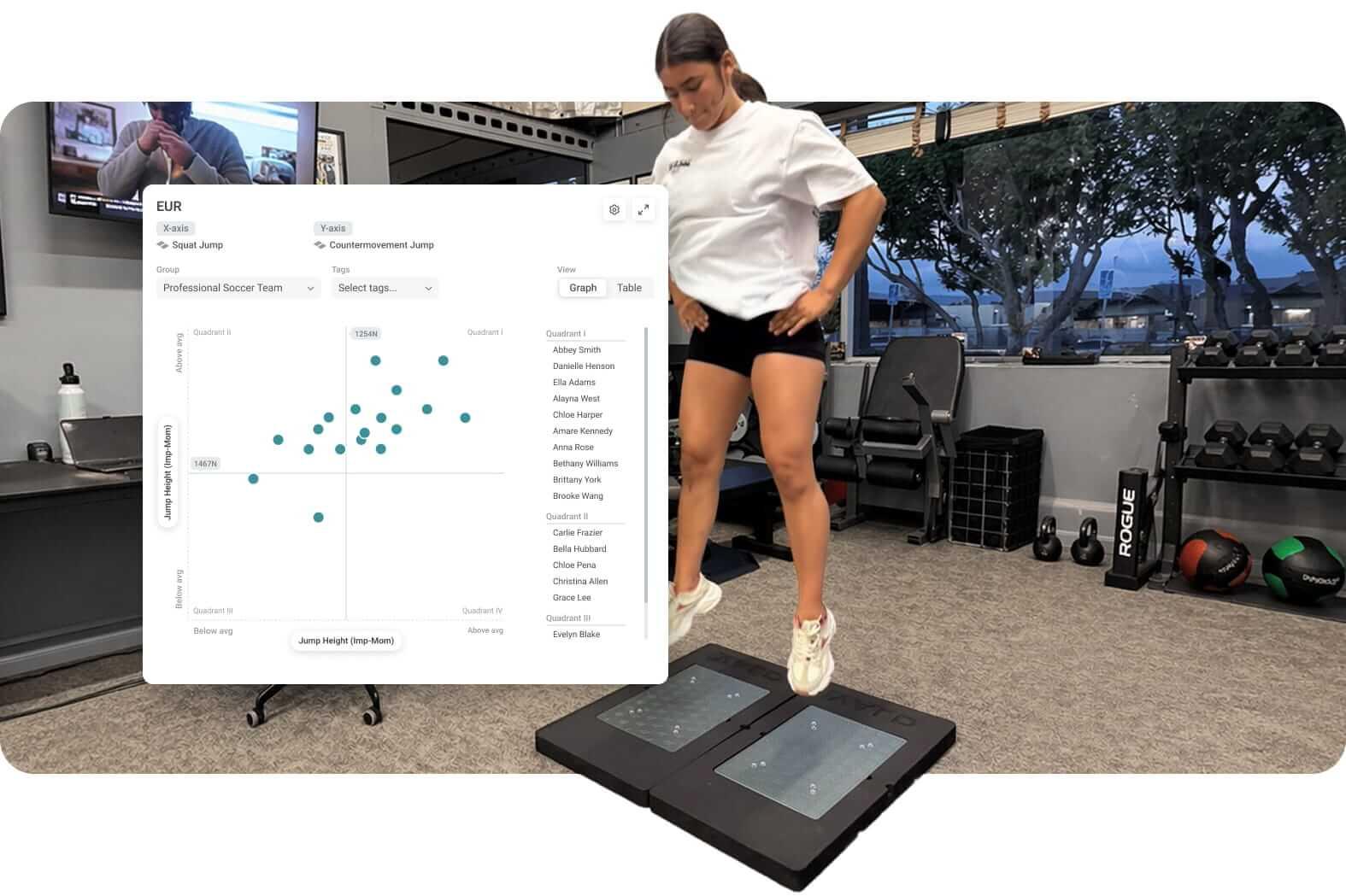
Athlete performing an SJ and CMJ protocol to calculate EUR.
For example, a high EUR with low jump heights may suggest an athlete is utilizing the SSC well but lacks overall force and power capacity. Conversely, a lower EUR alongside high jump performance may reflect elite concentric power, which may be a sport-specific adaptation rather than a limitation requiring intervention.
In both cases, EUR adds value when it guides deeper assessment, rather than when it is used to make isolated training decisions.
Factoring the EUR Into Practice
EUR provides a useful lens into an athlete’s jump performance, but its value is limited when interpreted in isolation. Pairing the ratio with CMJ and SJ outputs, particularly with tools like Quadrant Reports, allows practitioners to separate performance qualities and become better equipped to answer performance questions. Used in this way, EUR helps guide targeted assessment and informed decision-making.
To learn more about interpreting EUR alongside CMJ and SJ performance, or using ForceDecks to contextualize jump outputs, get in touch with our team.
References
- Bobbert, M. F., Gerritsen, K. G., Litjens, M. C., & Van Soest, A. J. (1996). Why is countermovement jump height greater than squat jump height? Medicine and Science in Sports and Exercise, 28(11), 1402–1412. https://doi.org/10.1097/00005768-199611000-00009
- Holmes, J. W. (2006). Teaching from classic papers: Hill’s model of muscle contraction. Advances in Physiology Education, 30(2), 67–72. https://doi.org/10.1152/advan.00072.2005
- Komi, P. V. (2000). Stretch-shortening cycle: A powerful model to study normal and fatigued muscle. Journal of Biomechanics, 33(10), 1197–1206. https://doi.org/10.1016/s0021-9290(00)00064-6
- Kozinc, Ž., Smajla, D., & Šarabon, N. (2024). Is larger eccentric utilization ratio associated with poorer rate of force development in squat jump? An exploratory study. International Biomechanics, 11(1), 1–5. https://doi.org/10.1080/23335432.2024.2341634
- McGuigan, M. R., Doyle, T. L. A., Newton, M., Edwards, D. J., Nimphius, S., & Newton, R. U. (2006). Eccentric utilization ratio: Effect of sport and phase of training. Journal of Strength and Conditioning Research, 20(4), 992–995. https://doi.org/10.1519/r-19165.1
