Understanding Metric Overlap: A practical guide for practitioners
Available in:
EN
About the Author
Dylan Carmody is a physical therapist and strength and conditioning coach in Bend, Oregon, and a Technical Content Manager at VALD. His work as a physical therapist and with VALD focuses on making actionable information simple for therapists and coaches.
Background
Practitioners in performance and rehabilitation share a common goal: solving complex problems with simple, repeatable interventions.
However, with the development of new technologies, practitioners are now faced with additional challenges beyond their daily demands. These include making sense of unfamiliar metrics and ensuring that sophisticated tools remain clinically and practically meaningful in fast-paced environments.
With new data points, practitioners need a way to distill complex data into simple, tangible solutions.
With new data points, practitioners need a way to distill complex data into simple, tangible solutions.

While the depth of data provided by force plates is a strength, it can also be overwhelming; therefore, grouping metrics can help reduce the demands of data analysis. Rather than offering entirely distinct insights, some metrics often highlight different angles of a shared pattern. These relationships are seen in literature from authors such as Dr. Lachlan James, who has described strength domains, and Dr. Matt Bourne, who has applied these relationships in rehabilitation contexts.
This article explains how these patterns emerge, how to identify them and what strategies can help ensure the data delivers meaningful insights rather than noise.
Mathematical Relationships
As the number of independent variables we measure increases, the likelihood of measurement overlap also rises, even when those variables are designed to measure distinct constructs. A relationship between any two randomly selected metrics (e.g., eccentric peak velocity [EPV] and peak landing force) is likely coincidental.
However, as more metrics are introduced, the number of unique metric pairs rapidly grows, and with it, the chance that two or more metrics will capture similar aspects of performance.

Visual depiction of the seemingly exponential increase in unique pair opportunities with increasing group members.
This follows the same mathematical principle as the Birthday Paradox, which shows that just 23 individuals are needed in a room for there to be a 50% chance that two share a birthday. This surprisingly low number is due to the rapid, exponential increase in pairwise comparisons as more individuals are added.
In this analogy, each individual serves as an independent variable, highlighting how quickly overlaps between variables become likely as their number grows, even when each is intended to represent something unique.
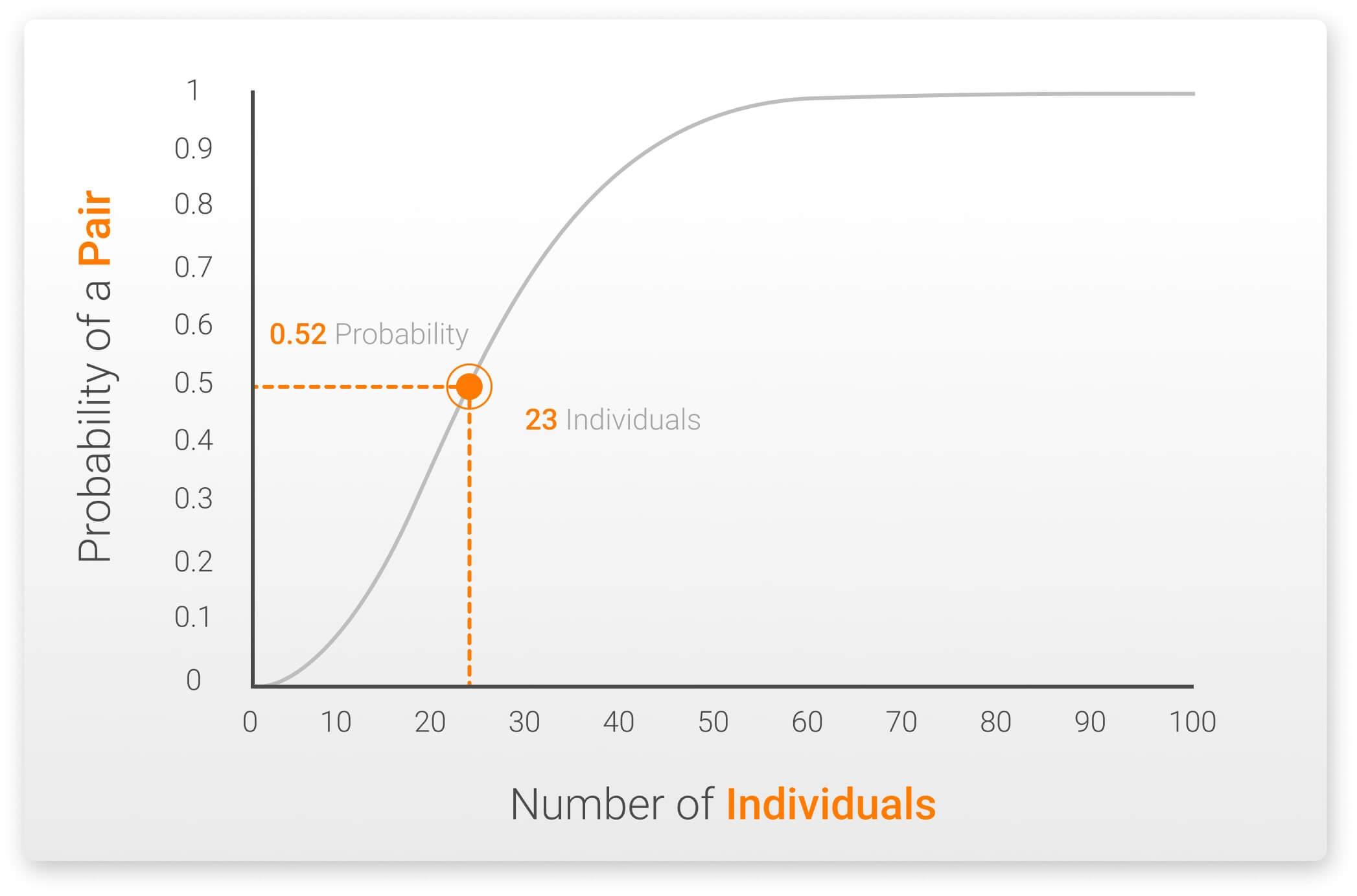
Graph representing the probability of a unique pair represented in a group of individuals.
As more metrics are added to an athlete’s profile or dashboard, the risk of accidentally measuring the same quality in different metrics increases.
As more metrics are added to an athlete’s profile or dashboard, the risk of accidentally measuring the same quality in different metrics increases. Without careful interpretation, this can lead to redundancy, noise and ultimately, poor decision-making. Understanding where overlap exists in a test battery or dashboard helps streamline metric selection, improve clarity and ensure that what is being tracked is meaningful.
How to Identify an Overlap
When multiple metrics shift in a similar pattern, they are collinear – meaning they move together due to a shared relationship. For instance, jump height and concentric impulse often improve in a similar pattern with training, creating potential redundancy in a dashboard if both metrics are being monitored.
The table below groups metrics that tend to cluster together at a broad population level, based on the statistical analysis later in this article. However, different athlete and patient groups will move in different ways, and those movement strategies can shift the strength of relationships between metrics. As a result, clusters may vary slightly depending on the population being tested.
| Stretch-Shortening Cycle Usage | Concentric Capacity | Eccentric Capacity | Jump Strategy |
|
|
|
|
In many health and performance scenarios, adding multiple collinear metrics will increase complexity without providing value. Measuring and monitoring can slow data interpretation, make analysis more challenging and lead to false conclusions, particularly if execution errors result in metric divergence.
Measuring and monitoring can slow data interpretation, make analysis more challenging and lead to false conclusions…
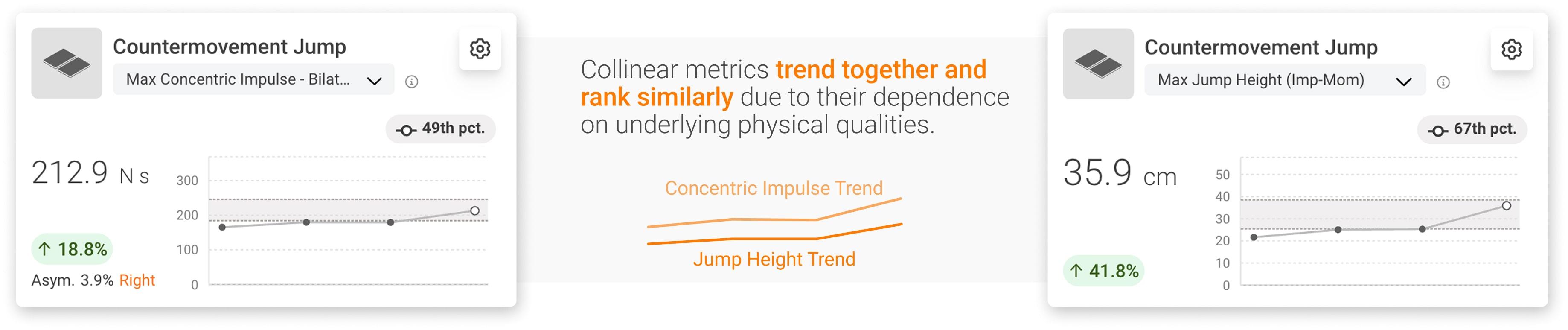
Two metrics that are collinear will follow the same or similar trendlines.
Even worse, if practitioners are monitoring multiple collinear metrics, changes in performance may appear more significant than they truly are.
Grouping by Construct
Rather than treating each metric as unique, a more effective approach is to group metrics into conceptual clusters – collections of metrics that are highly correlated with one another. This can be executed through two methods:
- Rationalize: Practitioners can form assumptions about specific metrics that likely relate to each other. Although this method is faster, it carries the risk of generating incorrect assumptions about a dataset or biomechanical relationships.
- Calculate: Practitioners can also perform statistical analyses, such as principal component analysis (PCA), using platforms like R to identify which metrics are most strongly correlated. Data can be easily exported from ForceDecks, ForceFrame and NordBord into these platforms using valdr to build bespoke analyses with raw data.
In the PCA below, the metric clusters generally align with those in the table above. However, differences in jump strategy across athletes and positions can shift how strongly metrics relate, which in turn can change how they cluster.
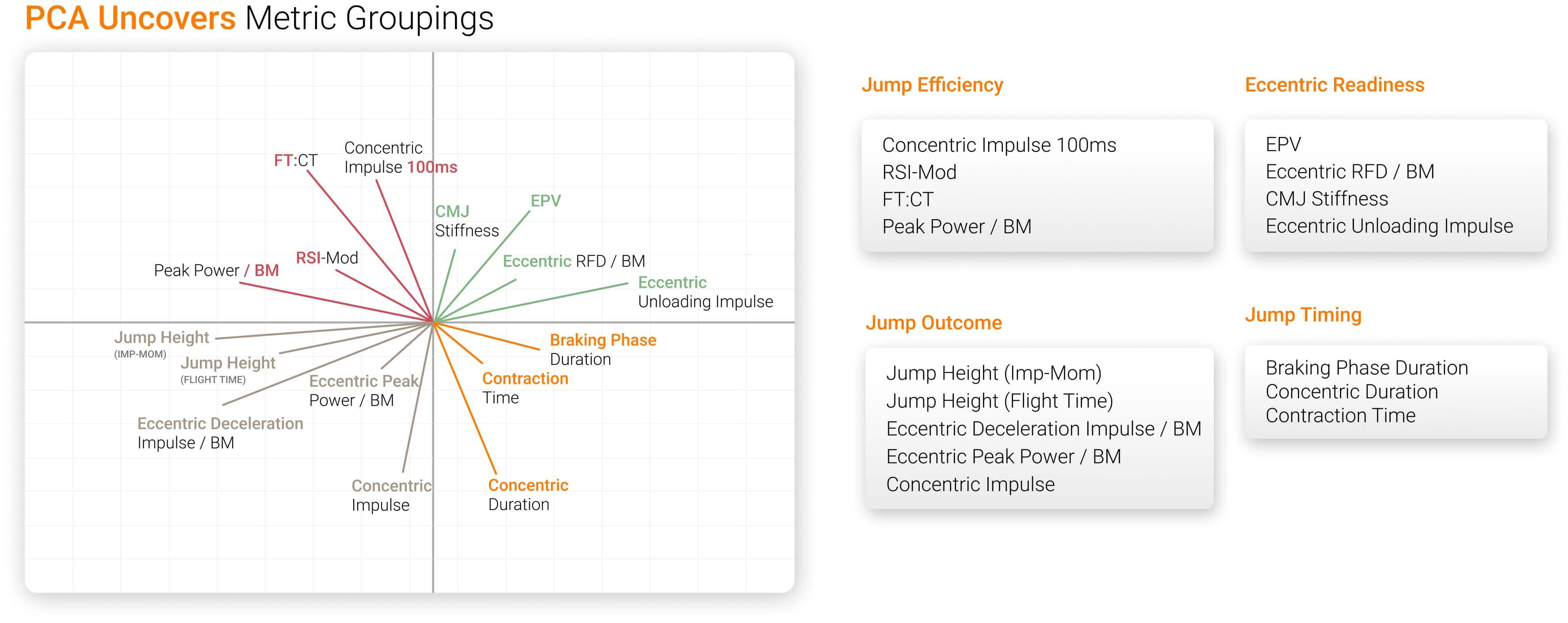
Sample PCA performed on 30 high school basketball athletes who had been assessed more than three times with the countermovement jump (CMJ).
For practitioners new to force plate assessments, the following metrics offer a well-rounded overview by capturing distinct, independent performance qualities based on the assessed data:
- RSI-Mod: Reflects explosive efficiency by combining jump height and contraction time
- EPV: Indicates eccentric speed during the takeoff phase
- Jump Height: Measures overall jump outcome and lower-limb power expression
- Contraction Time: Captures the duration of force production and influences jump strategy
Similarly, for practitioners with limited time to perform analyses, VALD Resources – such as the 2024/25 Basketball Data Report, which is available to VALD users in VALD Hub – provide similar clusters and groupings of metrics. Data reports, Practitioner’s Guides, articles and podcasts can all help practitioners refine their metric selection process when building patient or athlete dashboards.
VALD Resources…[can] help practitioners refine their metric selection process when building patient or athlete dashboards.
Limitations and Pitfalls
Examples like these are often misinterpreted. A PCA helps identify which combinations of variables explain the greatest variance in a data set and highlight metrics that may provide overlapping information. To apply this information effectively, practitioners should consider whether the clustered variables share an underlying physical or physiological mechanism. Otherwise, the relationship may simply reflect a spurious correlation.
…practitioners should consider whether the clustered variables are linked by an underlying physical or physiological mechanism…
Clustering should guide interpretation, not dictate which metrics to use or exclude. It helps reveal relationships between metrics and supports more focused, individualized dashboard design.
Although metrics may fall within the same cluster, they may not be interchangeable as they reflect similar, but not identical, underlying qualities. Therefore, it is up to the practitioner to interpret these groupings, understand the potential relationships between metrics and determine which variables offer the most meaningful insight for the individual’s assessment, monitoring or return-to-play process.
Next Steps
Critical thinking remains a constant requirement for sports and health practitioners. Those who critically assess metric relationships can tease apart how clusters form and how they ultimately influence decision-making.
Mathematical relationships show us that overlap between metrics is possible when monitoring multiple metrics. Tracking and interpreting every possible metric increases redundancy, while blindly picking a single metric is likely incomplete.
Clarity comes from understanding which metrics correlate and why, allowing practitioners to prioritize the most relevant data to guide effective decisions.
If you would like to learn more about simplifying data interpretation and using VALD’s human measurement technology to focus on what truly matters, reach out to our team here.
