My Dashboard: Jo Clubb
Available in:
EN
My Dashboard is a series featuring insights from health and performance experts on the tests and metrics they use to identify performance and rehabilitation deficits. Each article breaks down their VALD Hub dashboard, which has been optimized for a specific type of athlete or patient, outlining key tests, metrics and training insights to help practitioners better integrate testing data into practice.
Contributor

Sports Profile
Team sports are chaotic environments requiring performance across sprinting, cutting, jumping and endurance, which necessitates broad testing parameters to capture key performance characteristics. This dashboard provides a practical starting point for practitioners building team-sport monitoring systems.
Team sports…[require] performance across sprinting, cutting, jumping and endurance, which necessitates broad testing parameters to capture key performance characteristics.
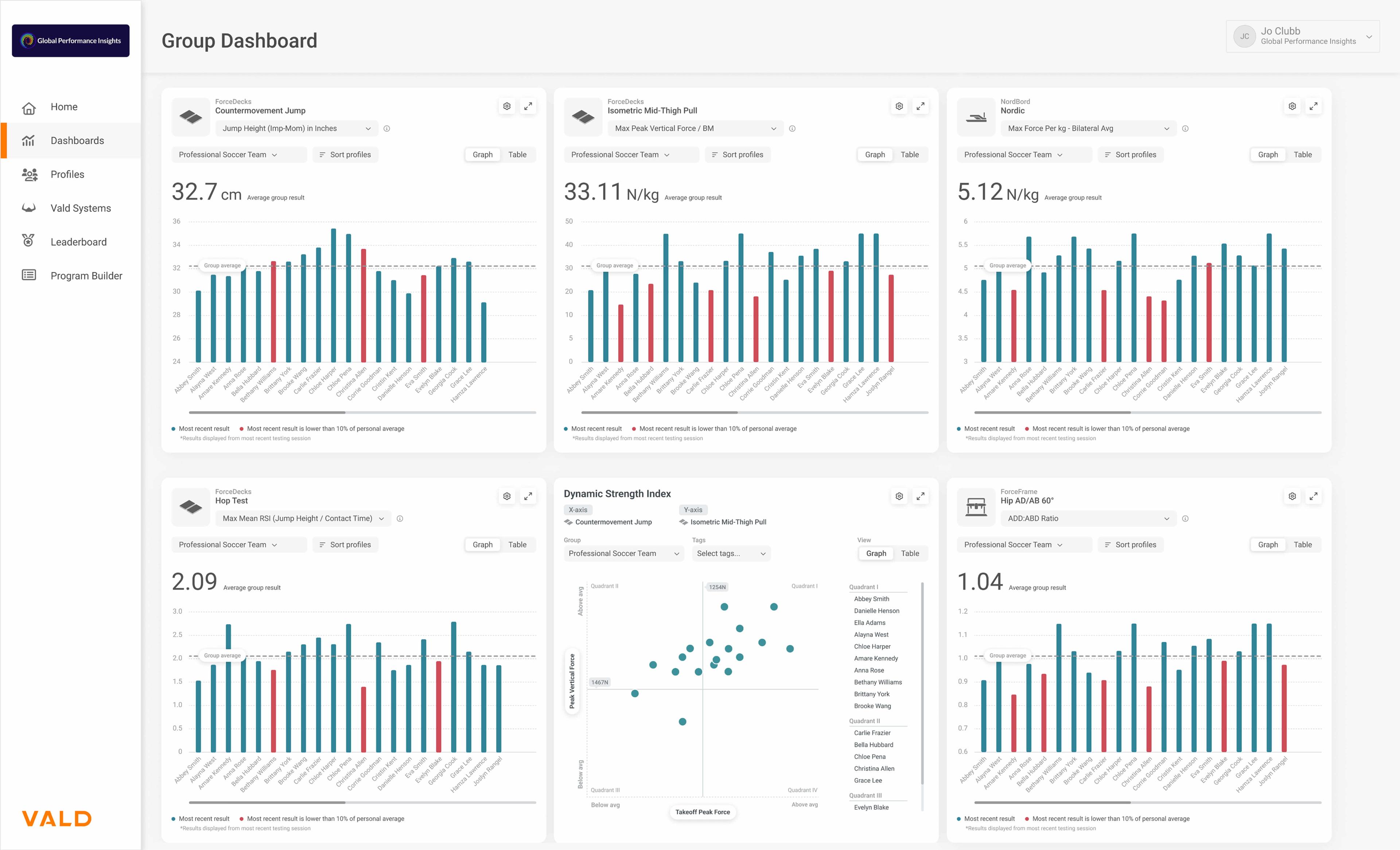
Jo Clubb’s VALD Hub dashboard highlighting a wide array of isometric, ballistic and plyometric physical performance data.
Overview
This dashboard provides a high-level overview of key physical capacities in team sports, combining the countermovement jump (CMJ), isometric mid-thigh pull (IMTP), hop test and targeted tests such as the Nordic and hip adduction and abduction tests for muscle-specific profiling. Together, these tests offer a concise snapshot of group profiles, with the Group Monitoring Dashboard helping practitioners compare results, monitor performance and identify meaningful changes over time.
These performance tests reflect how teams can align testing, technology and decision-making to better understand and manage athlete performance, something I commonly integrate through Global Performance Insights.
Countermovement Jump

| Test | Metric | Programming Consideration |
 | Jump Height (Impulse-Momentum) |
|
The CMJ provides a global view of neuromuscular performance. When assessed using force plates (e.g., ForceDecks), it yields a wide range of metrics that can be applied to physical profiling, fatigue and rehabilitation monitoring or return-to-play decision-making.
…[the CMJ] yields a wide range of metrics that can be applied to physical profiling, fatigue and rehabilitation monitoring or return-to-play decision-making.
At a group level, output metrics such as jump height can be used to quickly visualize explosive capabilities across a squad. Group monitoring dashboards allow results to be sorted by value or alphabetically, enabling an ordered comparison across the selected group.
Isometric Mid-Thigh Pull
| Test | Metric | Programming Consideration |
 | Peak Force (N) |
|
| Peak Force / BM (N/kg) | ||
| Dynamic Strength Index (DSI) |
|
DSI values and thresholds taken from Sheppard et al. (2011).
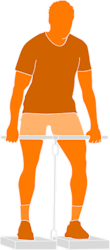
The IMTP provides an overall assessment of maximal strength by measuring the force produced during a maximal pull against an immovable bar (Wang et al., 2016). Peak force is commonly used as the primary outcome and reflects an athlete’s maximal force-generating capacity.
Peak force can be viewed in absolute or relative terms, including bodyweight (N/N) or body mass (N/kg). Expressing force relative to the athlete enables clearer communication and more meaningful comparisons across athletes of different sizes and positions, supporting the development of role-specific benchmarks.
[Peak] force relative to the athlete enables clearer communication and more meaningful comparisons across athletes…
Force outputs from the CMJ and IMTP can also be combined to calculate the DSI, which reflects the relationship between an athlete’s maximal isometric force capacity and the force they can express during a high-velocity ballistic movement, such as a jump.
This comparison can help guide programming decisions, as shown in the table above. However, these thresholds are not universal and should be interpreted within sport-, position- and population-specific contexts. They are most valuable when comparing athletes on the same team or program.
Hop Test
| Test | Metric | Programming Consideration |
 | Average Reactive Strength Index (RSI) |
|
Reactive strength is the physical ability to rapidly transition from eccentric to concentric muscle action, supporting efficient force absorption and redirection during movements such as jumping, sprinting and change of direction (Young, 1995).
The hop test (10/5 hop test) demands a more intense stretch-shortening cycle stimulus than the CMJ, as per the plyometric continuum. It assesses reactive strength using RSI, calculated as jump height divided by ground contact time. The 10/5 hop test evaluates reactive strength by reporting the best five hops, providing insight into an athlete’s ability to sustain performance across multiple contacts.
As a ratio-based metric, RSI should be interpreted alongside its component variables, jump height and contact time, to better understand individual strategies and physical profiles.
As a ratio-based metric, RSI should be interpreted alongside its component variables…to better understand individual strategies and physical profiles.
Nordic

| Test | Metric | Programming Consideration |
 | Nordic Peak Force / BM (N/kg) |
|
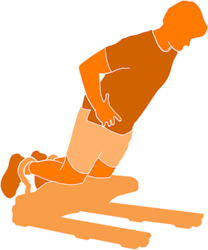
When conducted on NordBord, the Nordic provides a high-fidelity assessment of eccentric knee-flexor capacity. Peak force / BM reflects the greatest force produced during the movement, often occurring just before failure. Left and right limbs are also measured individually, allowing practitioners to assess asymmetry data.
Greater eccentric force capacity within the hamstring muscle group is important for many team sports, as it enables the hamstrings to generate and tolerate the high forces required during high-speed running and sprinting.
Hip Adduction and Abduction 60°

| Test | Metric | Programming Consideration |
 | Adduction Peak Force |
|
| Abduction Peak Force | ||
| Adduction-to-Abduction Ratio |
Team sports place high demands on the hip and groin due to frequent actions such as change of direction, jumping, kicking and sprinting.
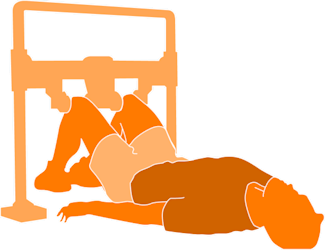
Hip adduction and abduction strength testing assesses the maximal force production of the hip and groin, with testing options at 0°, 45°, 60° and 90° of hip flexion on ForceFrame. Force outputs can be combined to create an adduction-to-abduction ratio, which highlights the balance of strength across the hip and groin region. Notable imbalances, meaning a ratio less than 0.8, are associated with greater injury risk (Tyler et al., 2001).
How These Tests Integrate
This dashboard provides a high-level overview of critical physical capacities for team sports performance, including power, global maximal strength, reactive strength and muscle group-specific strength and asymmetry.
Practitioners can quickly compare athletes across a squad with this dashboard, as well as dive deeper into individual dashboards to monitor trends over time and identify meaningful changes that may influence training or rehabilitation decisions.
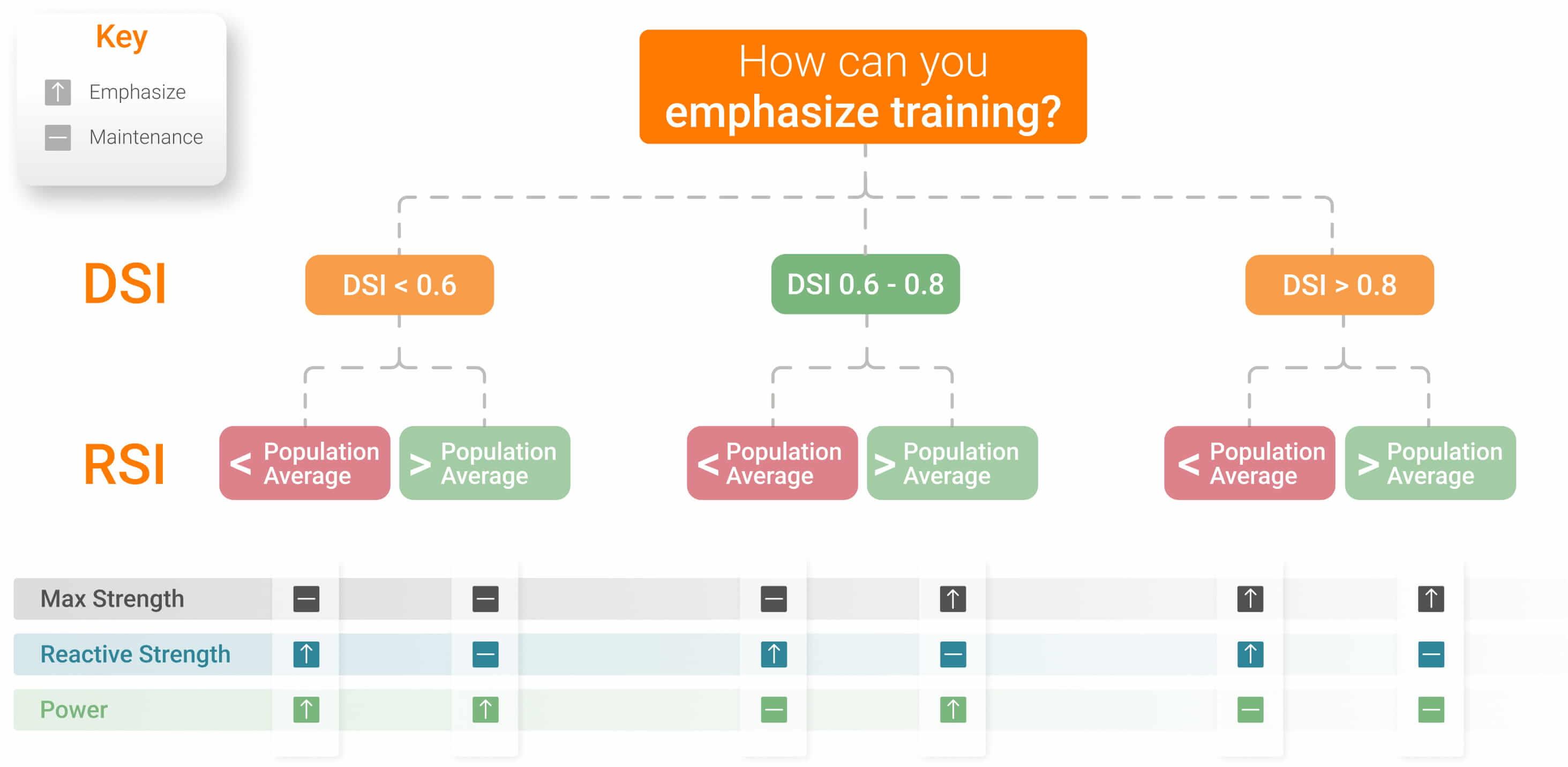
When these insights are considered collectively rather than in isolation, they support a more integrated understanding of athlete capacity. The flowchart above highlights a training prescription decision tree that integrates outputs from the CMJ and IMTP using DSI, alongside RSI capacity from a hop test.
When these insights are considered collectively rather than in isolation, they support a more integrated understanding of athlete capacity.
These guide the overall emphasis of the program, while joint- or muscle-group-specific insights from the NordBord and ForceFrame identify potential deficits that need addressing through accessory work.
Interested in building your own dashboard or applying similar methods to team-sport profiling and monitoring? Get in touch with our team.
References
- Sheppard, J. M., Chapman, D. W., & Taylor, K. (2011). An evaluation of a strength qualities assessment method for the lower body. Journal of Australian Strength and Conditioning, 19(2), 4–10. https://www.strengthandconditioning.org/jasc-19-2/1338-peer-review-an-evaluation-of-a-strength-qualities-assessment-method-for-the-lower-body
- Tyler, T. F., Nicholas, S. J., Campbell, R. J., & McHugh, M. P. (2001). The association of hip strength and flexibility with the incidence of adductor muscle strains in professional ice hockey players. The American Journal of Sports Medicine, 29(2), 124–128. https://doi.org/10.1177/03635465010290020301
- Wang, R., Hoffman, J. R., Tanigawa, S., Miramonti, A. A., La Monica, M. B., Beyer, K. S., Church, D. D., Fukuda, D. H., & Stout, J. R. (2016). Isometric mid-thigh pull correlates with strength, sprint, and agility performance in collegiate rugby union players. Journal of Strength and Conditioning Research, 30(11), 3051–3056. https://doi.org/10.1519/jsc.0000000000001416
- Young, W. (1995). Laboratory strength assessment of athletes. New Studies in Athletics, 10(1), 89–96.
