Understanding Horizontal Jump Analysis in HumanTrak
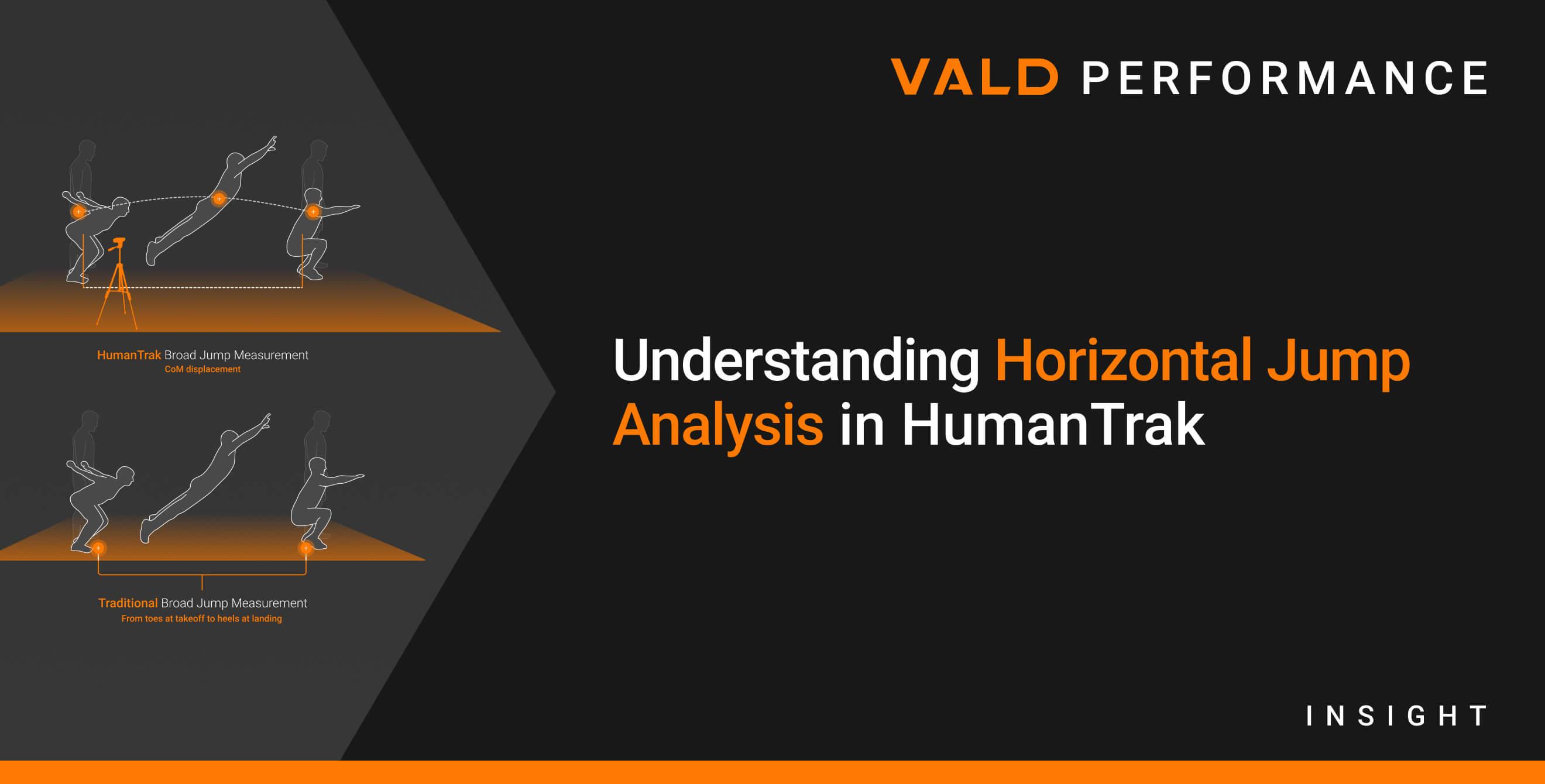
HumanTrak’s ability to assess and analyze horizontal jumping capacity enables practitioners to gain detailed insights into broad jump performance. Built on the same center-of-mass (CoM) tracking used in its vertical jump analysis method, horizontal jump analysis provides an objective assessment of how athletes execute jumps for distance.
…horizontal jump analysis provides an objective assessment of how athletes execute jumps for distance.
What the System Measures
Rather than relying on a tape measure or subjective visual judgment, HumanTrak quantifies the true movement of the body’s CoM during the jump, offering a biomechanically accurate representation of horizontal jump performance. HumanTrak now captures three key components of horizontal jumping:
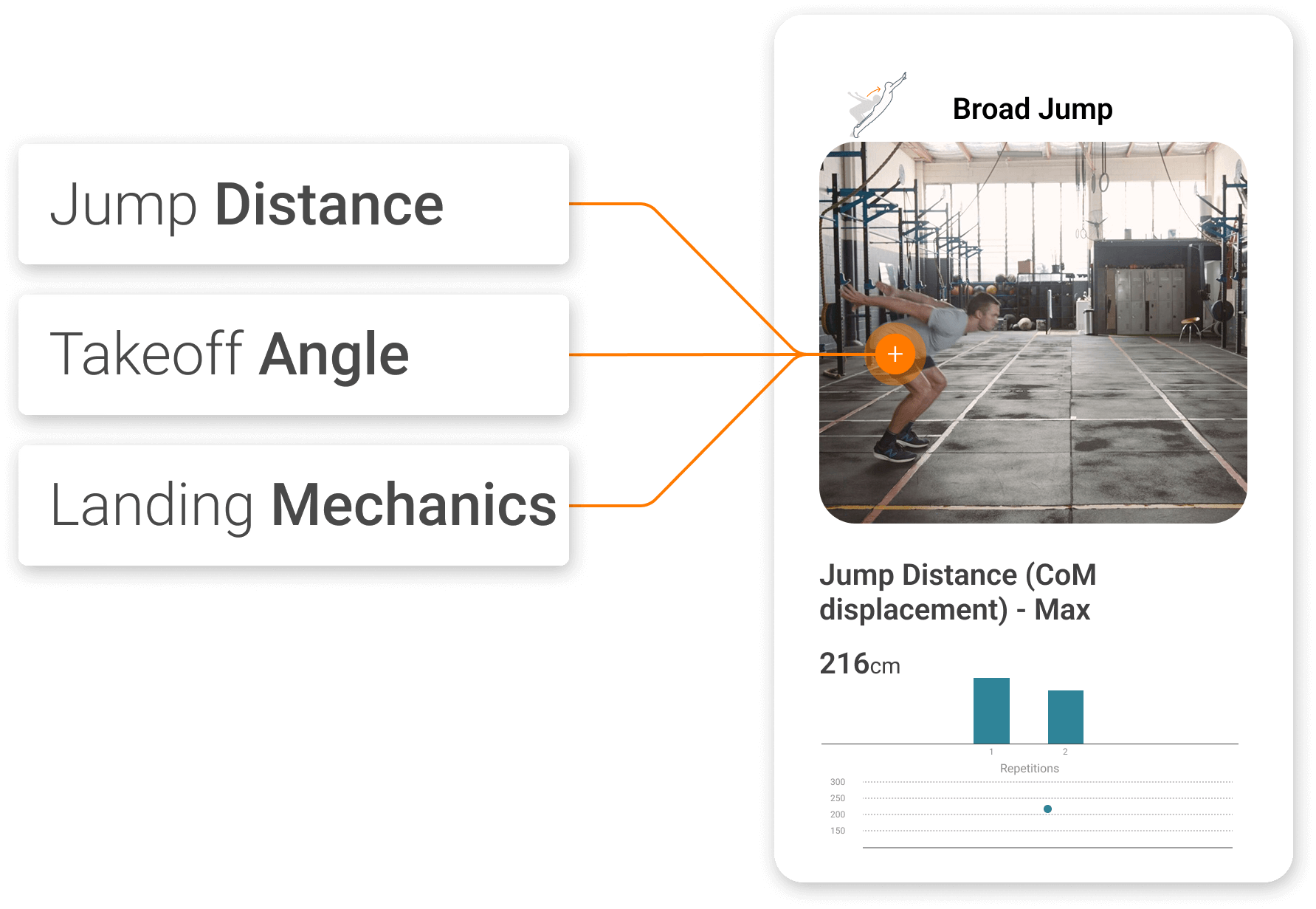
- Jump Distance: The system calculates the CoM’s forward displacement during the repetition. Because trunk lean can influence CoM position during takeoff and landing, HumanTrak captures movement from the start of the repetition in a quiet stand position until one second after landing to avoid distortion of displacement results. This differs from the approach used in traditional measures, which rely on toe-to-heel distance rather than the athlete displacement captured by HumanTrak.
- Takeoff Angle: The system calculates the takeoff angle by measuring vertical and horizontal velocity just before the athlete leaves the ground, identifying the athlete’s horizontal jumping strategy.
- Landing Mechanics: The system measures the landing phase, providing objective insight into deceleration control and stability using metrics such as peak trunk flexion on landing.
Together, [jump distance, takeoff angle and landing mechanics] allow practitioners to link distance outcomes to the movement strategies that created them.
Together, these metrics allow practitioners to link distance outcomes to the movement strategies that created them.
How Horizontal Displacement Is Determined
In HumanTrak, jump distance is calculated using the change in the CoM position across the screen during a broad jump. This represents the true displacement of the body’s CoM between the start of the repetition (standing still) and landing (Wakai & Linthorne, 2005). In field-based settings, jump distance is traditionally recorded from the toe at takeoff to the heel at landing. This controls for the athlete’s foot length in traditional measurement strategies.
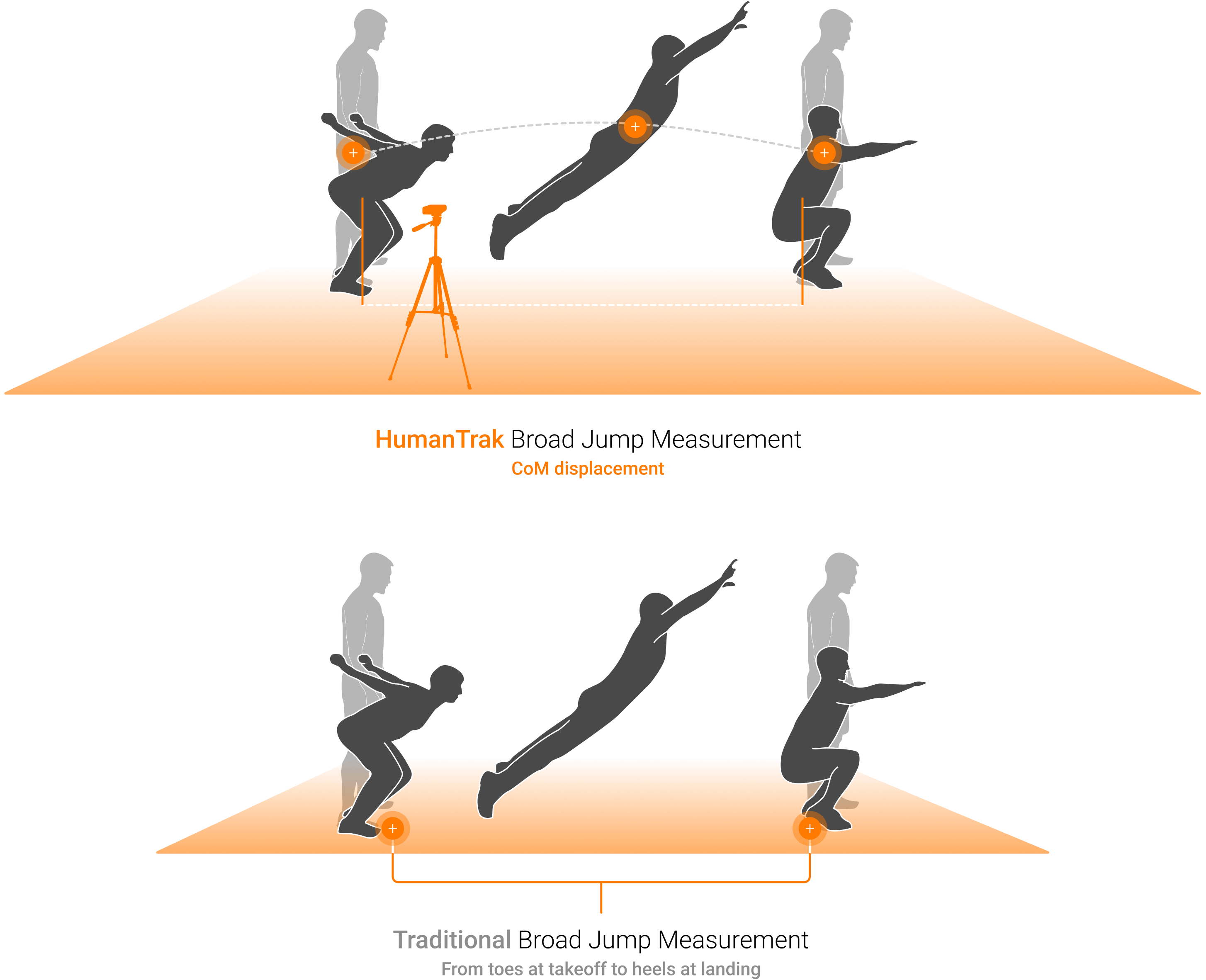
Different options between HumanTrak’s CoM measurement and traditional tape-measure broad jump assessments.
Because HumanTrak isolates the CoM, horizontal displacement in the system will commonly present 20-30cm longer than manual methods.
Because HumanTrak isolates the CoM, horizontal displacement in the system will commonly present 20-30cm (8-12in) longer than manual methods. This difference is expected and consistent, and it does not affect within-system comparisons over time.
How Takeoff Angle Is Determined
HumanTrak calculates takeoff angle using standard biomechanical principles (Wakai & Linthorne, 2005). Two velocity components of the CoM are estimated from its position in the final frames of ground contact:
- Horizontal Velocity: How fast the CoM is moving forward.
- Vertical Velocity: How fast the CoM is moving upward.
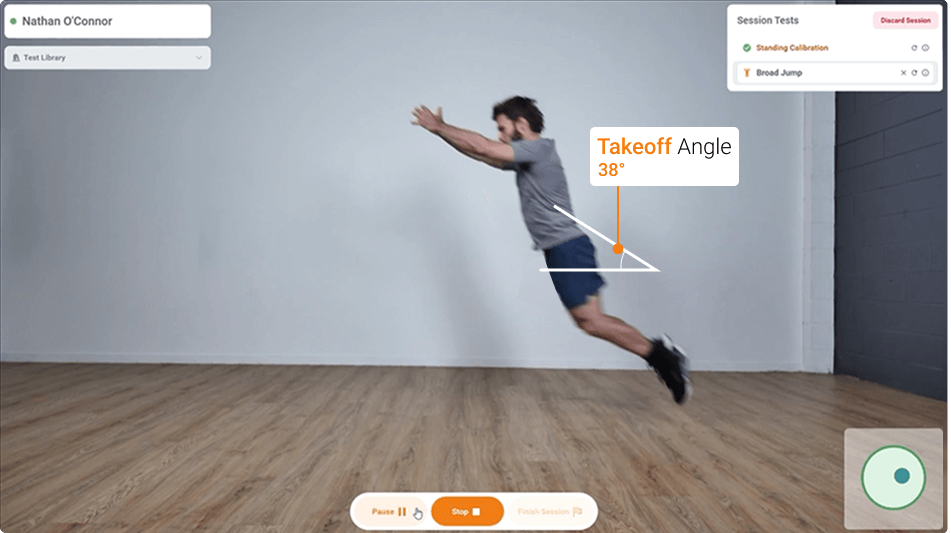
HumanTrak’s takeoff angle measurement visualized.
HumanTrak calculates takeoff angle…[by estimating horizontal and vertical velocity] of the CoM in the final frames of ground contact.
These two velocities form a “velocity vector.” The angle of that vector relative to the horizontal indicates the takeoff angle. Higher angles suggest more vertical lift; lower angles indicate more forward projection. In standing broad jumps, most trained athletes naturally take off between 19° and 27°, which research indicates is close to optimal for distance (Wakai & Linthorne, 2005).
By understanding and analyzing these components separately, practitioners can identify key drivers in horizontal jumping performance. For example, if an athlete has a takeoff angle that is too high and demonstrates poor jump distance, they could theoretically improve their horizontal jump performance in the following ways:
- Producing more force during the jump
- Lowering their takeoff angle
- Increasing force while lowering the takeoff angle
However, without measuring at least one of these metrics, practitioners would not be able to determine which jump strategy (e.g., change in force or takeoff angle) was the driver of increased jump distance. In this case, by tracking takeoff angle, practitioners can make the following deductions:
- Increased Jump Distance with a Shallower Takeoff Angle: Distance changes were improved (at least in part) by adjusting the takeoff angle.
- Increased Jump Distance with the Same Takeoff Angle: Distance changes were improved (most likely) due to increased force production.
Because HumanTrak uses precise 3D CoM tracking, metrics like jump distance and takeoff angle are consistent and accurate, supporting a more objective assessment technique than traditional measures.
Why It Matters
Horizontal jumps are integral to many sports and rehabilitation pathways, requiring propulsion ability, inter-limb coordination, landing control and overall lower-body power. HumanTrak’s horizontal jump feature brings clarity to these qualities by providing the following:
- True body displacement, not influenced by foot position
- Objective takeoff mechanics, free from visual estimation
- Repeatable measurement, allowing meaningful comparison over time
HumanTrak’s horizontal jump feature brings clarity…by providing [true body displacement, objective takeoff mechanics and repeatable measurement]…
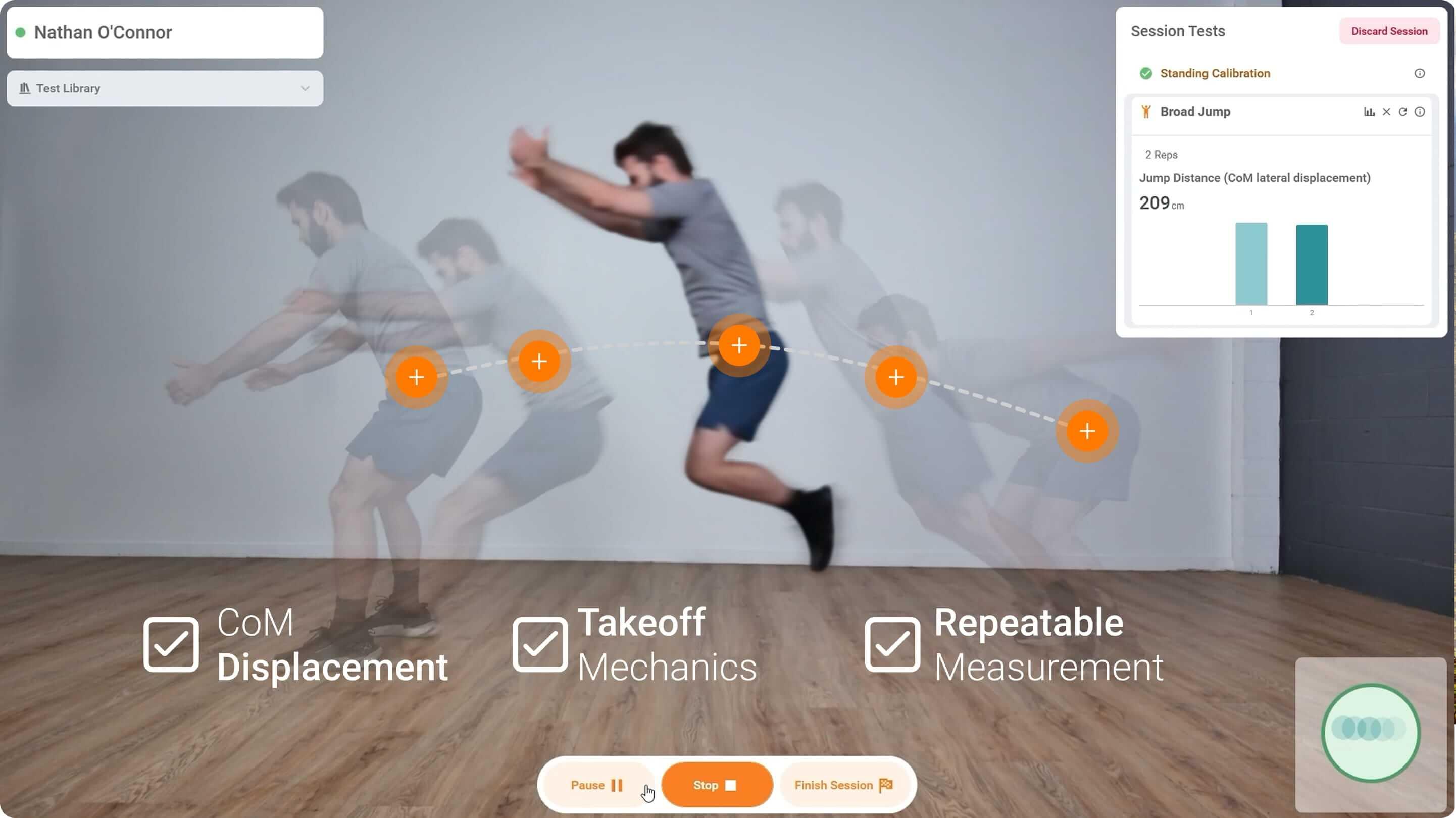
Specific features and metrics that HumanTrak provides with the broad jump assessment.
In high-volume environments such as combines or group screenings, HumanTrak’s processing allows large groups to be assessed quickly while maintaining consistency and accuracy. For clinicians and coaches, this means clearer identification of movement strategies, improved tracking for rehabilitation milestones and more precise monitoring of training adaptations.
Key Takeaway
The horizontal jump feature expands HumanTrak’s measurement capabilities by offering a detailed, biomechanically grounded assessment of forward and side-to-side jumping to complement vertical jumps. By focusing on CoM displacement, takeoff strategy and landing mechanics, HumanTrak provides a consistent, objective and repeatable way to understand horizontal jump execution.
If you would like to learn more about how HumanTrak can enhance movement assessment in your practice, please get in touch.
References
- Wakai, M., & Linthorne, N. P. (2005). Optimum take-off angle in the standing long jump. Human Movement Science, 24(1), 81–96. https://doi.org/10.1016/j.humov.2004.12.001
