Strength, Power and Landing Control Predict Fire-and-Movement Performance
Available in:
EN
Study Information
McCarthy, A., Fuller, J. T., Wills, J. A., Cassidy, S., Lovalekar, M., Nindl, B. C., & Doyle, T. L. A. (2025). Strength, jump height, landing, and mobility metrics predict high and low performers of a fire and move assessment: A machine learning approach. Medicine & Science in Sports & Exercise, 57(12), 2754–2763.
https://doi.org/10.1249/MSS.0000000000003822
Purpose of the Study
Combat maneuverability is fundamental to soldier survivability, particularly during rapid movements between cover positions under load. This study investigated which physical qualities best distinguish high and low performers on a continuous fire‑and‑movement assessment.
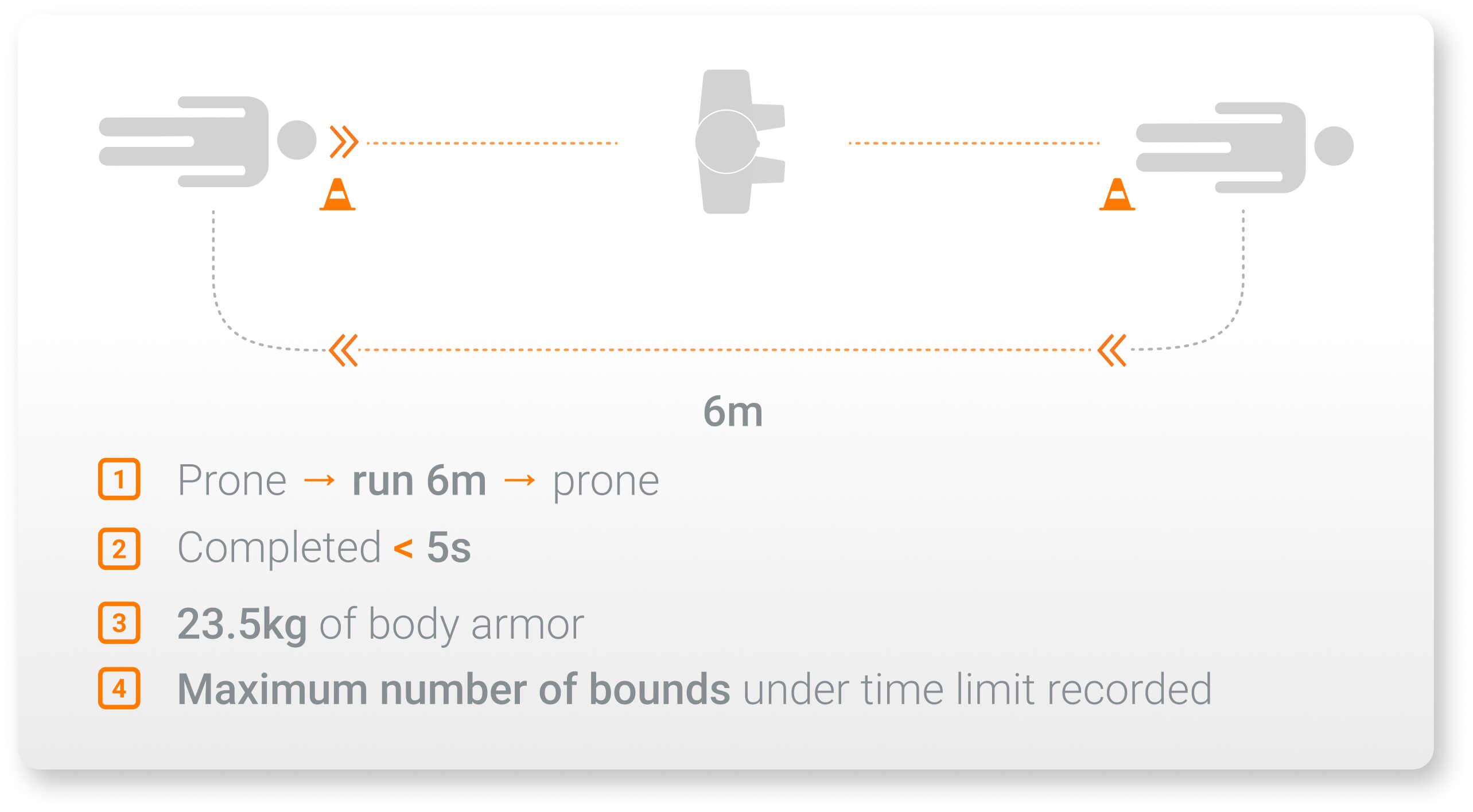
Using a combination of strength, power, landing and mobility tests, the study aimed to identify underlying physical factors through exploratory factor analysis (EFA) and determine whether machine‑learning models could accurately classify participants as high or low performers based on these factors.
Methods
34 recreationally active adults completed a comprehensive performance testing battery across two laboratory sessions. Physical qualities were assessed using ForceDecks, ForceFrame and HumanTrak technologies and included the following tests:
| Technology | Test |
| ForceDecks | |
| ForceFrame | |
| HumanTrak |
|
Participants then completed a lab‑adapted version of the Australian Defense Force fire‑and‑movement assessment while wearing 23.5kg of simulated armor. Participants who completed 50 bounds within the time limit were classified as high performers, whereas those with fewer were classified as low performers.
All collected physical metrics were analyzed using EFA, producing four latent performance factors, which were then used in logistic regression, multilayer perceptron and random forest models.
Key Findings
The EFA revealed four distinct physical components that collectively explained 81.46% of the variance in performance outcomes:
- Isometric Strength, Jumping and Drop Landing Ability: Included loaded and unloaded jump height, IMTP peak force, isometric push-up force, grip strength and relative landing force. The strength–power–landing factor showed a very large effect size (d = 2.15) and was approximately six times more influential than the other factors.
- Lower-Body Explosive Strength: Represented IMTP force at 50, 100, 150 and 200ms and demonstrated a moderate to large effect size (d = 0.72-0.81).
- Upper-Body Rate of Force Development (RFD): Captured RFD at 50, 100, 150 and 200ms during the isometric push-up and indicated a moderate to large effect size (d = 0.72-0.81).
- Overhead Squat Ability: Represented the ability to complete an overhead squat for depth with and without body armor and reflected a moderate to large effect size (d = 0.72-0.81).
The strength–power–landing factor showed a very large effect size (d = 2.15) and was approximately six times more influential than the other factors.
All factors differed significantly between high- and low-performing groups (P < 0.05), with high performers demonstrating higher mean values.
VALD’s Solution
Practitioners aiming to improve fire‑and‑movement and other tactical performance outcomes should prioritize lower‑ and upper‑body strength, loaded and unloaded jumping ability and controlled landing strategies. Mobility and explosive strength remain meaningful secondary targets that support movement quality and load‑bearing efficiency.
These findings highlight the importance of comprehensive neuromuscular profiling for predicting combat‑specific performance. VALD systems such as ForceDecks, ForceFrame and HumanTrak enable objective measurement of strength, jump performance and landing force, providing a practical framework for personnel selection, readiness monitoring and targeted intervention design.
If you would like to learn how ForceDecks, ForceFrame and HumanTrak can help you assess strength, power and landing control in your performance environment, get in touch with our team.
