Objective Testing for Golf Performance
Available in:
EN


Golf training has historically focused on technique refinement, leading practitioners to prioritize metrics such as club head speed, ball speed, launch angle and carry distance. Today, physical preparation is a welcome addition to golf training, with clear links between physical capacity and performance on the course.
Integrating objective physical testing alongside swing data provides a more complete profile. Measures of force production, ground reaction forces and movement strategy help explain performance outputs and better inform training decisions.
Why Physical Assessment Matters in Golf
Golf performance is driven by a combination of physical qualities that support technique, including rotational power, lower-body force production and efficient coordination of the kinetic chain (Robinson et al., 2026). Assessing these qualities helps guide training programs by providing practitioners with additional ways to improve performance beyond technique refinement.
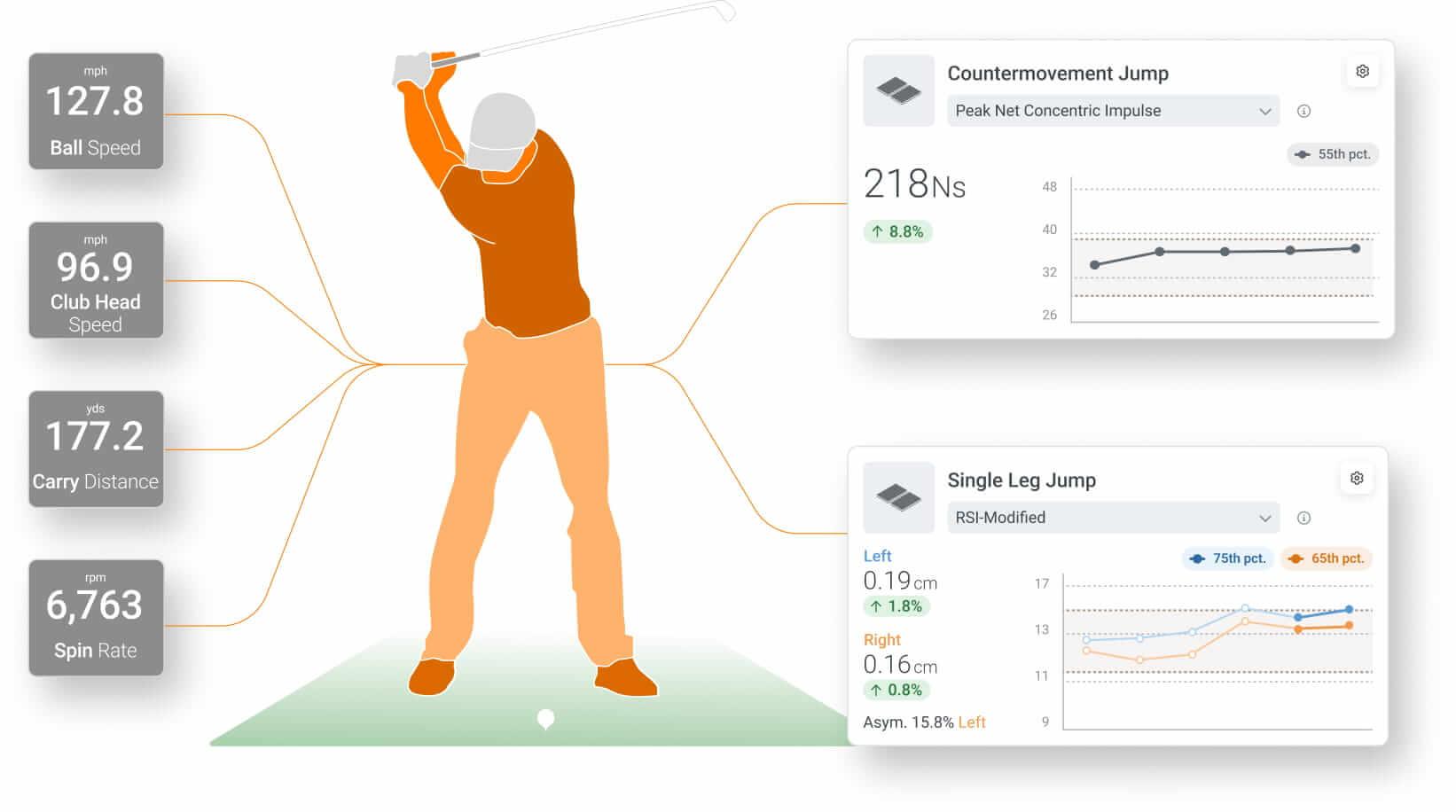
Relationships between key swing characteristics and physical performance measures from force plates.
Assessment technologies such as ForceDecks, DynaMo, ForceFrame and HumanTrak can help offer a structured way to quantify these physical attributes accurately, repeatably and at scale.
…ForceDecks, DynaMo, ForceFrame and HumanTrak can help…quantify [the] physical attributes [necessary for golf performance].
The integration of high-quality coaching, individualized training and advanced assessment technologies has enabled us to create our own physical profiling quadrant system.
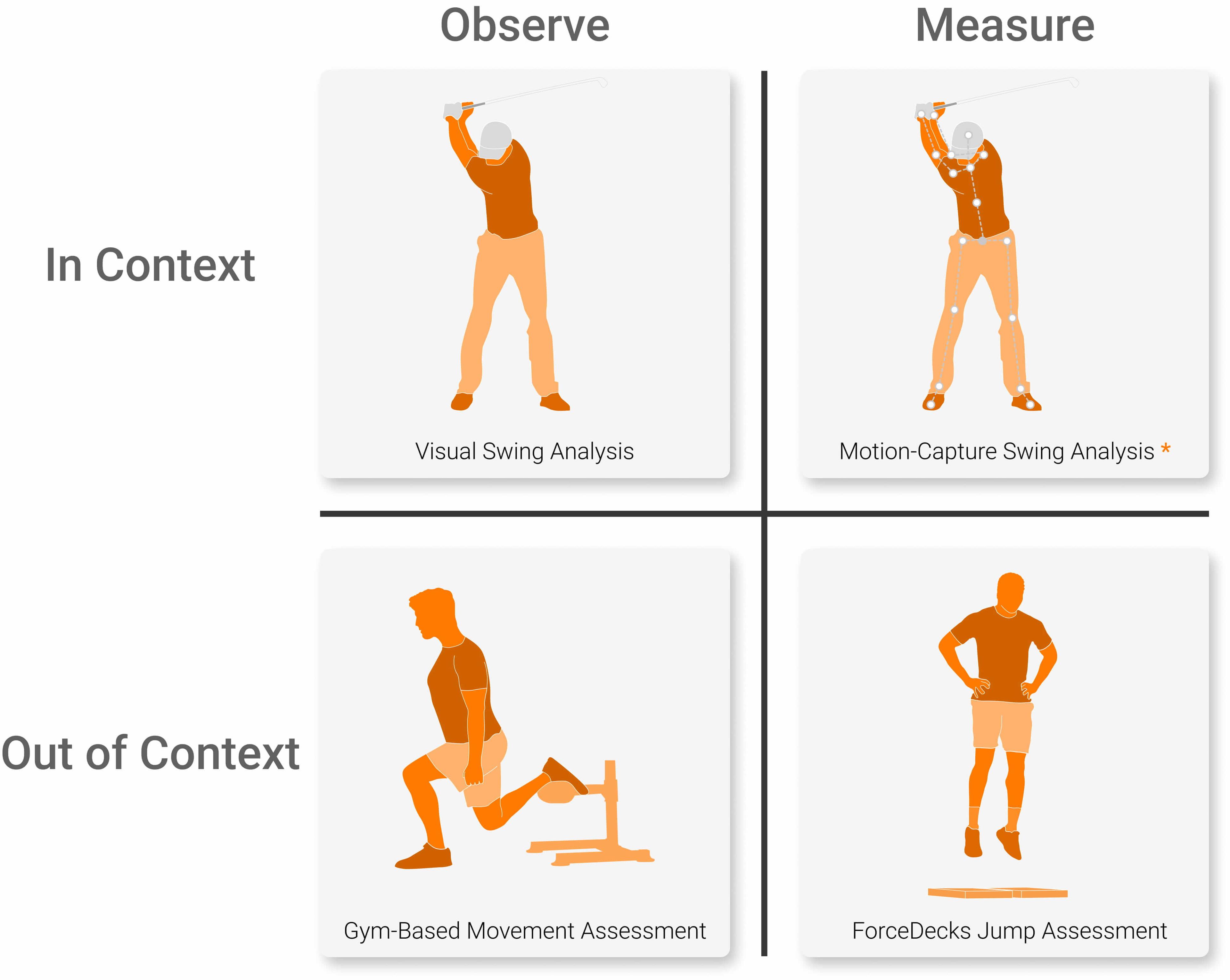
Examples of each quadrant within the physical profiling system. * Swing analysis is not currently available in the VALD ecosystem.
By combining observations with objective performance data, this system helps practitioners reverse-engineer each athlete’s physical demands, creating a clearer understanding of the qualities that drive performance and the areas that require development.
Key Assessments in Golf Performance
The team uses select tests to help assess some of the physical qualities most relevant to golf performance.

Jump Assessment
The countermovement jump (CMJ) provides a global measure of lower-limb power within golf performance assessment. In this population, CMJ performance metrics have been linked to the following performance characteristics:
- Club head speed
- Ball speed
- Driving distance
This relationship between CMJ performance and in-context golf metrics has been established through the analysis of elite golfers’ positive takeoff impulse, which represents the summed impulse (force x time) produced above body weight throughout the takeoff phase of the jump (from the start of movement to the point of takeoff).
As a measure of an athlete’s ability to generate and transfer force into movement, positive takeoff impulse is the most researched and well-established metric linking force plate data to golf performance indicators (Bage et al., 2025).
…positive takeoff impulse is the most researched and well-established metric linking force plate data to golf performance indicators.
While the CMJ does not replicate the rotational and multidirectional demands of the golf swing, it remains an efficient and well-supported assessment of a physical quality strongly associated with golf performance.
Isometric Strength Testing
Along with dynamic power assessment, isolated strength testing helps identify specific limiting factors within the golf swing. Strength qualities related to the hips, trunk and lower body play an important role in force production and transfer throughout the swing from the ground up.
Isometric testing, like the isometric mid-thigh pull (IMTP), is commonly used due to its relationship with club head speed, force transfer and driving distance (Bage et al., 2025). However, we also use dynamometers such as ForceFrame and DynaMo to assess commonly injured sites more specifically. Additional isometric tests include:
- Hip Abduction and Adduction: Contributes to pelvic control and lower-body force transfer.
- Trunk Rotation Strength: Supports rotational force production throughout the swing.
- Hip External and Internal Rotation: Influences swing mechanics and rotational capacity.
Together, these assessments provide insight into force production, segmental control and underlying performance changes that may influence the golf swing. The tables below establish performance standards for elite golfers, collected by our team.
Female Golf Profiling Standards
| Percentile | IMTP Peak Force – Net of Body Weight (N) | CMJ Positive Takeoff Impulse (N.s) | CMJ Net Impulse (N.s) | Body Mass (kg) |
| Top 10% | 1,607 | 296 | 179 | 80 |
| Top 25% | 1,454 | 275 | 164 | 72 |
| Average | 1,322 | 253 | 151 | 67 |
| Bottom 25% | 1,171 | 221 | 139 | 62 |
| Bottom 10% | 975 | 208 | 129 | 59 |
Male Golf Profiling Standards
| Percentile | IMTP Peak Force – Net of Body Weight (N) | CMJ Positive Takeoff Impulse (N.s) | CMJ Net Impulse (N.s) | Body Mass (kg) |
| Top 10% | 3,004 | 418 | 262 | 96 |
| Top 25% | 2,687 | 401 | 247 | 88 |
| Average | 2,364 | 370 | 230 | 83 |
| Bottom 25% | 2,076 | 338 | 216 | 78 |
| Bottom 10% | 1,913 | 312 | 200 | 74 |
Source: Daniel Coughlan
Practitioners can use the findings of these tests to guide subsequent strength training protocols for both performance and rehabilitation needs.
Movement Assessment
In addition to kinetic performance variables, we use HumanTrak to conduct kinematic screens with LET athletes at various time points throughout the season. These screens are important for evaluating range-of-motion constraints, including hypermobility, that may influence the technique and movement strategy required for elite golf performance. HumanTrak enables markerless motion capture to assess joint angles, sequencing and movement economy.
We evaluate pelvis and trunk rotation alongside broader measures of mobility and movement coordination throughout the body. Assessments such as shoulder total arc and the squat help identify movement restrictions, asymmetries or coordination deficits that may influence swing mechanics and overall performance.
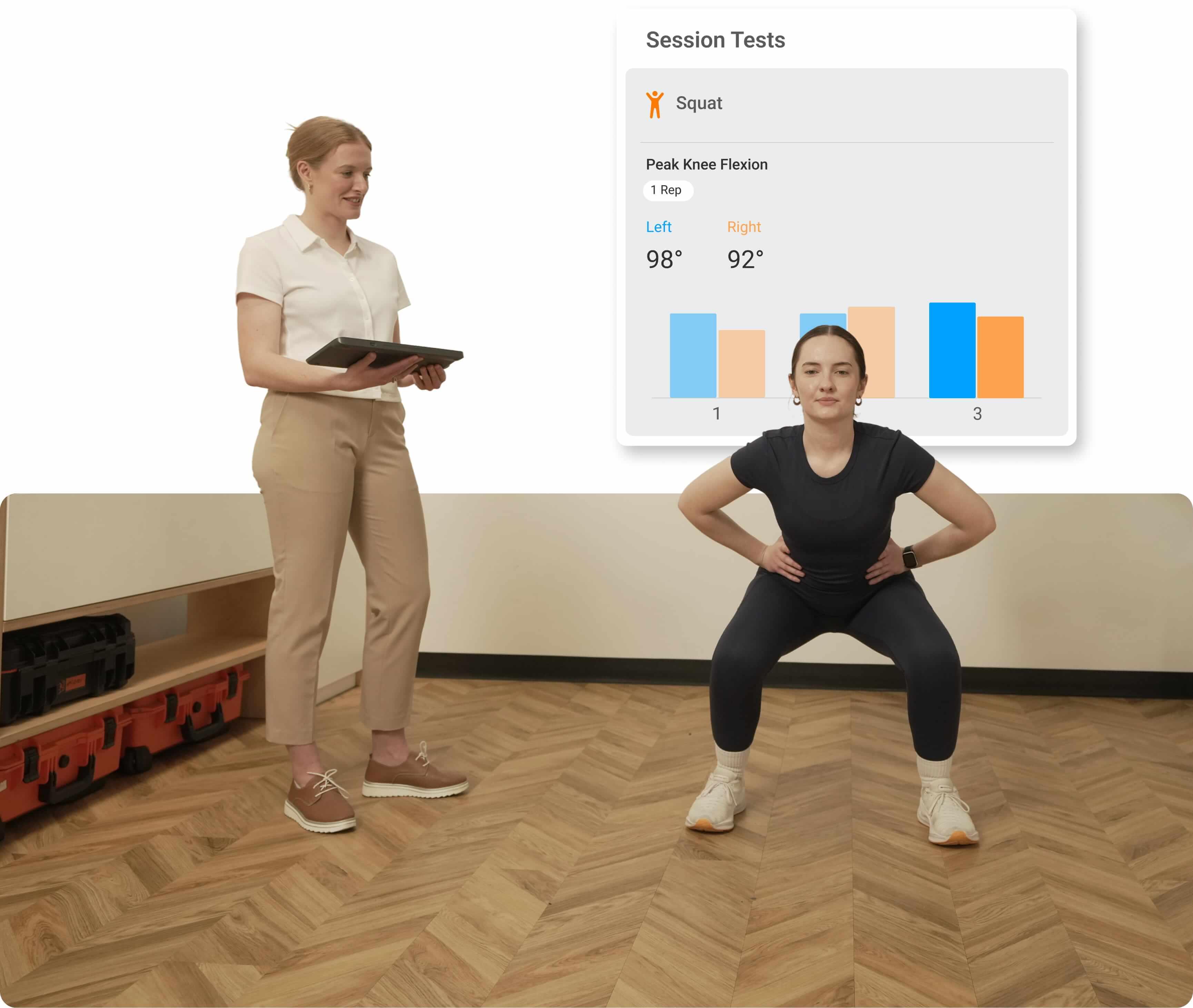
HumanTrak has built-in custom analysis options that allow practitioners to create screening batteries and golf-specific assessments. Captured movement data can be useful for skill and performance coaches when identifying how physical capacity is expressed during the swing.
Motion capture can help golfers identify movement restrictions resulting from in-season stressors such as travel, environmental changes and competition. This helps practitioners determine whether movement strategy issues are best addressed through technique refinement or through long-term adaptations achieved with strength training.
Motion capture can help golfers identify…whether movement strategy issues are best addressed through technique refinement or through long-term adaptations achieved with strength training.
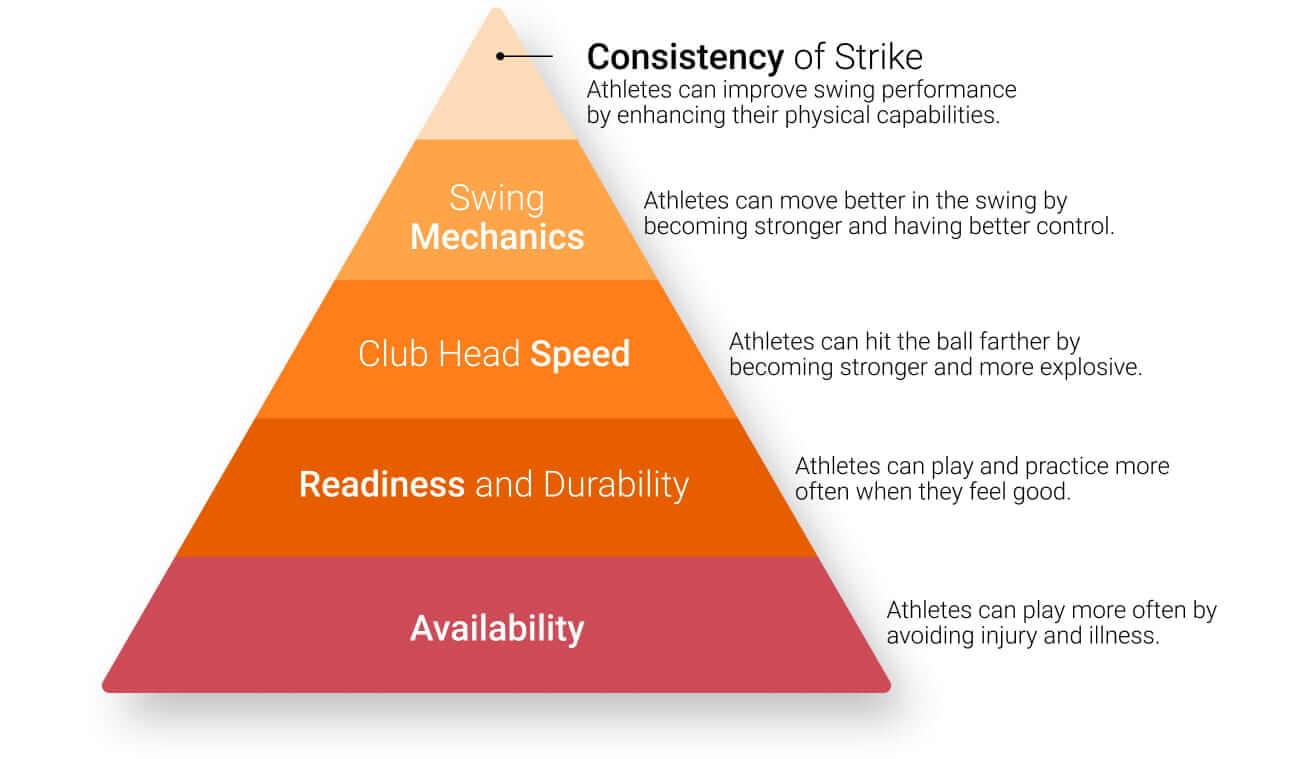
The DP World Tour and LET testing framework is built around identifying and improving the physical qualities most likely to influence golf performance. This approach led to the development of the Probability of Performance Impact Pyramid, which guides assessment selection and athlete monitoring by prioritizing factors based on their potential impact on performance.
In this diagram, the base of the pyramid represents the areas where performance training is likely to have the greatest impact, while the top represents areas with the least supporting evidence for a meaningful performance effect.
Case Study: Single Leg Jump and Swing Speed
The following case study highlights how objective assessment can be used to investigate a specific performance question. In this case, we wanted to identify opportunities to improve clubhead speed in a tour-level professional golfer.
Initial swing analysis showed that faster swings were associated with a quicker backswing and an earlier transfer of force from the trail leg to the lead leg, allowing force to be applied through the lead leg sooner during the downswing.
Rather than progressing through a predetermined testing battery, these findings helped direct the assessment process, with additional testing selected to better understand the physical qualities underpinning this movement strategy. The testing battery included:
- Single leg jump (left and right)
- CMJ
- Swing speed assessment
Key Findings
Single leg jump testing identified asymmetries in force-time characteristics, including longer contraction times and reduced reactive strength index-modified (RSI-Mod) on the trail limb. These findings aligned with observed limitations in the golfer’s ability to rapidly load and unload the trail leg during the backswing and transition force effectively toward the lead side. The results informed targeted interventions from both skill and performance staff, with subsequent improvements observed in both jump performance and clubhead speed.
This case highlights the importance of selecting assessments to answer specific performance questions rather than following a standardized battery. Once swing analysis identified trail-to-lead leg force transfer as a potential performance limiter, single leg jump testing was used to investigate the underlying physical qualities.
This case highlights the importance of selecting assessments to answer specific performance questions rather than following a standardized battery.
More broadly, athletes with greater unilateral jump performance often demonstrate higher swing speeds, while substantial asymmetries may contribute to less consistent swing performance despite strong bilateral jump outputs.

Practical Application for Practitioners
Integrating technology-enabled assessments into golf environments allows for more targeted intervention strategies to accompany technique screenings. Practitioners can apply this approach by following three key steps:
- Establish a Baseline: Use a consistent testing battery that includes tests such as the CMJ, as well as isometric strength tests relevant to golf like the IMTP.
- Compare to Performance Metrics: Overlay physical data with skill-based metrics, such as swing speed, ball speed and performance outcomes, to identify whether limitations are physical (capacity-driven) or technical (execution-driven).
- Target Interventions: Based on findings, address deficits with unilateral strength and power training, develop rate of force development where needed and reinforce movement strategies through integrated training.
Golf performance is ultimately the product of both technical skill and physical capacity. Objective assessment allows practitioners to reverse engineer performance by identifying the physical qualities that underpin swing outcomes, then targeting the limitations most likely to influence performance.
By integrating technologies such as ForceDecks, DynaMo, ForceFrame and HumanTrak, practitioners can quantify these qualities, monitor adaptation over time and create greater alignment between golf coaches and performance staff, helping connect assessment, training and on-course performance within a single framework.
If you would like to learn more about how VALD technologies can support golf performance through objective testing, physical profiling and targeted intervention, get in touch with our team.
References
- Bage, T. N., Bishop, C., Coughlan, D., & Wells, J. E. T. (2025). Can the variance in DP World Tour golfers’ drive distance be predicted from kinetic variables during a countermovement jump and isometric mid-thigh pull? Journal of Strength and Conditioning Research, 39(9), 982–988. https://doi.org/10.1519/JSC.0000000000005079
- Robinson, L., Murray, A., Coughlan, D., Ehlert, A., Heeney, C., Turner, A., & Bishop, C. (2026). A 12-week strength and conditioning intervention: An individualised case series approach for 3 amateur and 3 professional female golfers. Journal of Strength and Conditioning Research, 40(4), e373–e384. https://doi.org/10.1519/JSC.0000000000005342
