Maturity and Nordic Strength in Youth Female Soccer
Available in:
EN
Study Information
Hickey, J. T., Lundberg, T. R., Sweeney, C., MacNamara, Á., & Sweeney, L. (2026). Influence of chronological age, anthropometric characteristics and biological maturity on eccentric knee flexion strength during the Nordic hamstring exercise in female international youth soccer players. European Journal of Sport Science, 26(3), e70135.
https://doi.org/10.1002/ejsc.70135
Purpose of the Study
The Nordic hamstring exercise (NHE) is widely used in female football injury‑prevention programs, with prevalence over three times higher than in male academies (Bandak et al., 2024; McQuilliam et al., 2022). However, interpreting NHE data in adolescent athletes can be complicated, as youth athletes of the same chronological age can be at markedly different stages of physical development, which can substantially influence test performance.
Therefore, this study aimed to determine how chronological age, anthropometric characteristics (body mass and height) and biological maturity influence eccentric knee flexion strength (Nordic max force) during the NHE in female international youth soccer athletes.
Methods
The study included 50 under‐15‐year‐old and 31 under‐16‐year‐old female international youth soccer athletes. All athletes completed three maximal NHE repetitions using NordBord to quantify Nordic max force. Maturity status was estimated using the percentage of predicted adult height (PAH%), a commonly used, noninvasive maturity indicator (Khamis & Roche, 1994).
Statistical analysis sought to identify predictors of eccentric strength through linear regression for individual predictors and partial least squares (PLS) regression for combined predictors.
Key Findings
- Body Mass: Showed the strongest association with Nordic max force (R² = 0.34, p < 0.01).
- Biological Maturity (PAH%): Demonstrated a significant association with Nordic max force (R² = 0.18, p < 0.01).
- Chronological Age: Indicated a weaker but statistically significant association with Nordic max force (R² = 0.06, p = 0.03).
- Height: Demonstrated that height alone was not a significant predictor of Nordic max force (R² = 0.03, p = 0.11).
- Exploratory PLS Model for Nordic Max Force: Highlighted that strength development during adolescence is driven more by maturation and body mass than age alone.
…strength development during adolescence is driven more by maturation and body mass than age alone.
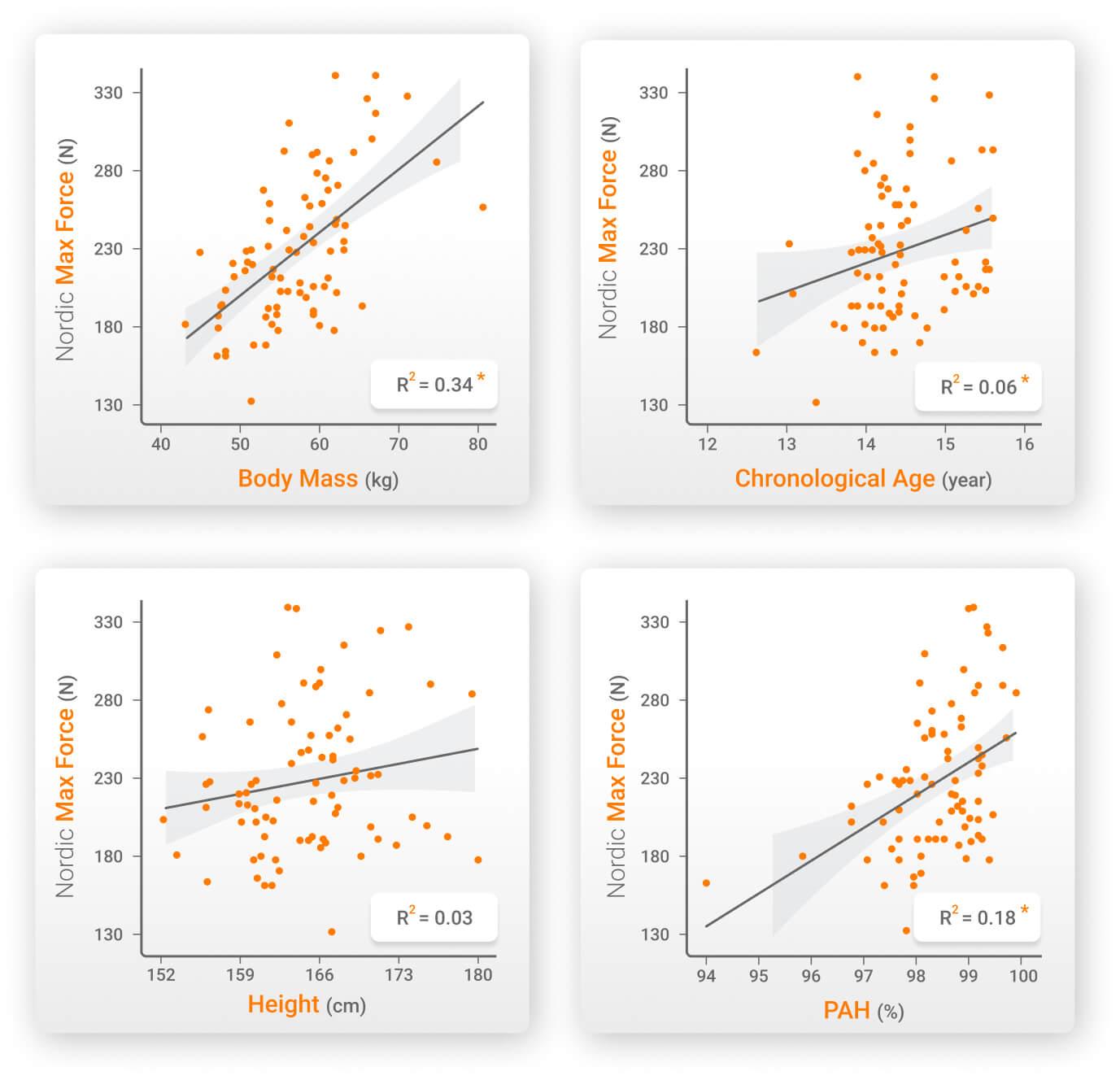
Nordic max force on the y-axis and associations with each predictor variable on the x-axis. Orange asterisks (*) indicate statistical significance (p < 0.05).
VALD’s Solution
The findings align with insights from VALD Norms, emphasizing contextual benchmarks instead of single cutoff scores. They highlight the importance of maturity-informed interpretation of normalized eccentric hamstring strength data in female international youth soccer athletes.
NordBord enables repeatable, time-efficient, lower limb-specific assessment of eccentric knee flexor capacity in a field-based environment using the NHE. By combining NordBord data with available measures, such as body mass and PAH%, practitioners can do the following:
- Avoid penalizing late-maturing athletes who may show lower eccentric forces despite appropriate neuromuscular control.
- Identify early-maturing athletes whose higher forces may mask movement quality or strength deficits.
- Differentiate between true training adaptations and growth-related strength gains.
- Recognize that sudden increases in strength may reflect growth-driven load capacity changes, not tissue readiness.
If you would like to learn how NordBord can help you assess eccentric knee flexor strength and interpret NHE data within the context of growth and maturation, get in touch with our team.
References
- Bandak, E., Zebis, M., Alkjaer, T., Nielsen, S., Bennike, S., & Thorborg, K. (2024). Injury prevention training in girls’ and women’s elite football in Denmark: A survey of practices and perceptions. Scandinavian Journal of Medicine and Science in Sports, 34(7), e14696. https://doi.org/10.1111/sms.14696
- Khamis, H. J., & Roche, A. F. (1994). Predicting adult stature without using skeletal age: The Khamis–Roche method. Pediatrics, 94(4), 504–507. https://doi.org/10.1542/peds.94.4.504
- McQuilliam, S. J., Clark, D. R., Erskine, R. M., & Brownlee, T. E. (2022). Mind the gap! A survey comparing current strength training methods used in men’s versus women’s first team and academy soccer. Science and Medicine in Football, 6(5), 597–604. https://doi.org/10.1080/24733938.2022.2070267
