How To Create Buy-In Across an Organization
Available in:
EN

Sport science has advanced considerably in its ability to quantify human performance. Contemporary systems, such as ForceDecks, NordBord and the full VALD suite, support profiling, monitoring and return-to-play readiness. Despite these advances, the way this information translates into meaningful decision-making remains widely variable (Coutts, 2017).
In practice, the successful application of technology is shaped by both data quality and practitioner understanding. Buy-in determines whether data is understood, trusted and applied in ways that meaningfully inform behavior. At any level of an organization, buy-in is rarely binary, as the degree of engagement influences the extent of application and the role that technology plays within an interdisciplinary system.
How Technology Drives Individual Buy-In
For practitioners, successful implementation of any technology depends on adoption and genuine engagement in the training process. While enforcing individual compliance ensures data collection, it does not guarantee that assessments are conducted with appropriate intent or that the resulting data will meaningfully influence behavior.
Practitioners looking to improve their data collection process may first want to ensure individual buy-in is adequate. This is important for three reasons:
- Disengagement often leads to eventual program attrition
- Increased engagement improves data quality and program participation
- Quality data builds trust by providing individuals with objective feedback
Engagement and buy-in increase when individuals understand what is being measured and why it matters. When assessment results are clearly linked to decisions such as training modifications, recovery strategies and return-to-play progressions, individuals are more likely to engage with and invest in the process (Alfano & Collins, 2021).
Engagement and buy-in increase when individuals understand what is being measured and why it matters.
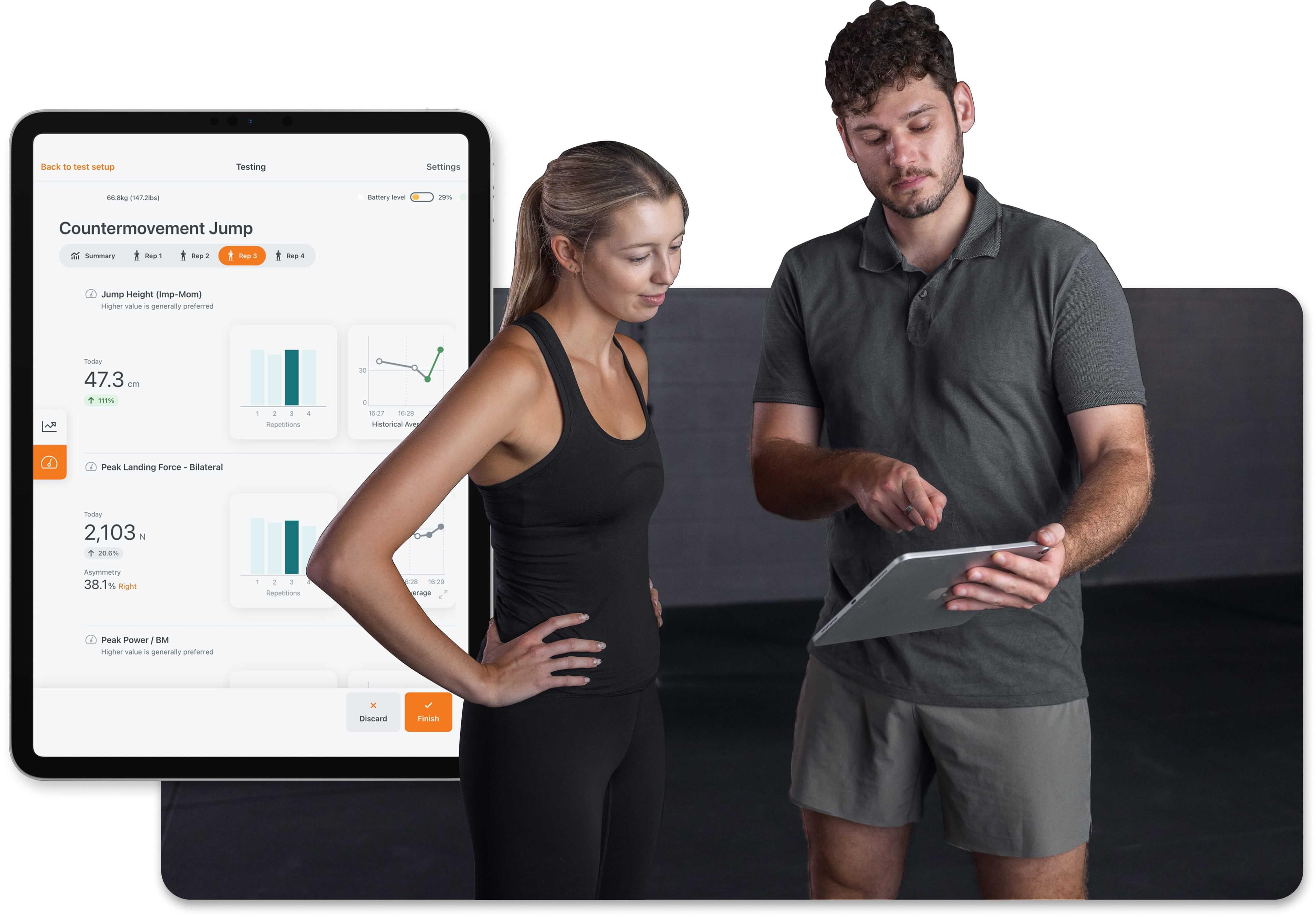
When individuals can immediately see how their effort influences performance outcomes, engagement with testing often improves. For example, force plate technologies like ForceDecks provide real-time feedback on metrics such as jump height, reactive strength index and force production, allowing individuals to instantly tune their effort to the performance metrics on-screen. This immediate feedback creates a clearer purpose for testing and can encourage greater intent during assessments.
From a business perspective, greater individual engagement can improve return on investment by supporting repeat visits, long-term retention and stronger perceived value. When individuals understand their results and can clearly see progress over time, they are more likely to remain invested in the rehabilitation or training process, benefiting both outcomes and the practice.
Giving individuals access to historical trends through public-facing apps like MoveHealth, along with benchmarking tools such as Norms, can further support engagement over time. These features help individuals understand their progress, compare performance against relevant reference groups and see objective evidence of improvement throughout rehabilitation or training.

Without objective data, individuals often rely solely on practitioner interpretation to judge progress. Making performance data visible helps demonstrate the value of ongoing care, reinforcing the need for continued rehabilitation or training. Over time, this can improve adherence, encourage repeat visits and strengthen return on investment by increasing the perceived value of the service.
Systems To Support Practitioner Buy-In
While individual buy-in is necessary, practitioner buy-in is often more significant. In most environments, practitioners determine whether data influences training, competition and rehabilitation decisions, ultimately determining whether technology advances care or hinders it.
…practitioners determine whether data influences training, competition and rehabilitation decisions…
Challenges often arise when departments define successful team performance differently or work toward misaligned goals. Coaches act as the critical gatekeepers between data collection and decision-making, highlighting the importance of translating sport science outputs into coaching language.
In these situations, data can be easily translated from numbers on a page into practical coaching decisions:
- Training Adjustments: Identifying a deficit in eccentric hamstring strength from NordBord may influence targeted strengthening blocks, modified return-to-play progression or added ‘top-up’ doses of hamstring strength during a microcycle.
- Loading Targets: Prescribing additional high-load training sessions may be appropriate for individuals with reduced adduction-to-abduction ratios. For example, ForceFrame Training Mode can set isometric training thresholds based on a percentage of an individual’s maximum strength, such as 90%, to ensure loading targets are met.
- Competitive Benchmarks: Using sport-specific benchmarks and target performances, such as a sub-11.0 second lane agility test, practitioners can feel more confident in return-to-play decisions following lower-limb injury (Mehran et al., 2016).
Buy-in is often strongest when testing and monitoring systems align with the broader coaching philosophy rather than operating independently (Fullagar et al., 2019).
Shared access to objective data through platforms like VALD Hub can improve communication across performance, rehabilitation and coaching staff. Tools such as monitoring charts and quadrant charts can also help stakeholders understand how an individual is progressing relative to teammates and their performance goals.

VALD Hub helps practitioners turn data into clearer conversations around progress, benchmarks and decision-making.
Shared access to objective data through platforms like VALD Hub can improve communication across performance, rehabilitation and coaching staff.
By aligning a shared decision-making framework with technology-enabled monitoring platforms, practitioners can learn from testing data and apply it to deliver individual outcomes that would not otherwise be possible. Ultimately, better outcomes drive a professional environment dedicated to best practice, leading to higher operational efficiency and greater overall practitioner buy-in.
How Technology Supports Organizational Buy-In
Beyond individual stakeholders, the sustainability of any testing system depends on how well it integrates with an organization’s operational and financial priorities (Coutts, 2017).
Organizations face challenges related to performance outcomes, staffing limitations, logistical constraints and return on investment (ROI) goals. Systems that are resource-intensive or difficult to embed within existing workflows are unlikely to be sustained, even when the evidence for effectiveness is strong.
When systems demonstrate clear utility, they are more likely to gain lasting institutional support (Alfano & Collins, 2021). Over time, this support compounds when successful implementation builds trust, leading to better ROI, such as enhanced client retention.
When systems demonstrate clear utility, they are more likely to gain lasting institutional support.
For example, organizations that embed standardized physical screening into preseason workflows, with documented thresholds that inform return-to-play criteria, create institutional memory of individual baselines. When a player is traded, re-signed or returns from injury, historical data informs medical and performance decisions regardless of practitioner turnover, reducing knowledge loss when practitioners change.
Showing that monitoring leads to a simpler athlete management process, with connections to lower injury burden, reduced time loss or improved workforce readiness, provides measurable ROI – one that translates across performance, clinical and operational priorities.
Building Systemic Trust
Across every level of buy-in, trust determines whether individuals fully engage, practitioners act on data and organizations commit to sustained implementation. This is built through consistent, transparent and contextually coherent application of technology over time.
Stakeholders’ understanding of how decisions are made and whether data is applied consistently and objectively can influence trust. When stakeholders see that data is systematically used to inform training, recovery and competition, confidence in the monitoring process increases.
Systematically integrating technology through validated systems, clear data visualization and intuitive workflows supports adoption and buy-in at every level of an organization.
If you are interested in learning how VALD’s human measurement technology can support buy-in, improve data-driven decision-making and help create measurable value in your organization, explore our Practitioner’s Guide to ROI or get in touch.
References
- Alfano, H., & Collins, D. (2021). Good practice in sport science and medicine support: practitioners’ perspectives on quality, pressure and support. Managing Sport and Leisure, 28(4), 396–411. https://doi.org/10.1080/23750472.2021.1918019
- Coutts, A. J. (2017). Challenges in developing evidence-based practice in high-performance sport. International Journal of Sports Physiology and Performance, 12(6), 717–718. https://doi.org/10.1123/IJSPP.2017-0455
- Fullagar, H. H. K., McCall, A., Impellizzeri, F. M., Favero, T., & Coutts, A. J. (2019). The translation of sport science research to the field: A current opinion and overview on the perceptions of practitioners, researchers and coaches. Sports Medicine, 49(12), 1817–1824. https://doi.org/10.1007/s40279-019-01139-0
- Mehran, N., Williams, P. N., Keller, R. A., Khalil, L. S., Lombardo, S. J., & Kharrazi, F. D. (2016). Athletic performance at the National Basketball Association Combine after anterior cruciate ligament reconstruction. Orthopaedic Journal of Sports Medicine, 4(5), 2325967116648083. https://doi.org/10.1177/2325967116648083
