From Data to Decision: Structuring clarity in high-performance sport

About the Author
Dr. Jarred Boyd is the Director of Rehabilitation for the Memphis Grizzlies, where he operates at the intersection of performance, clinical practice and return-to-play strategy. With a systems-thinking approach, Jarred integrates biomechanics, tissue-specific adaptation and neuromuscular diagnostics to solve complex reconditioning challenges.
His work is grounded in first principles thinking and guided by decision-making models that prioritize tissue health without sacrificing sport-specific readiness. He has contributed thought leadership to platforms such as The Science PT and continues to explore how signal, structure and context shape adaptive outcomes in elite sport.
Introduction
In the realm of high-performance sport, we are inundated with data. Force plate metrics, GPS outputs, isometric assessments and change-of-direction (COD) analyses populate dashboards daily. With all this information, it is tempting to assume that refining the validity of our assessments is the singular factor that leads to better decision-making.
This article takes a different angle: decision-making frameworks that help us move from raw signal towards action. Technology-enabled testing, such as jump or isometric assessments on ForceDecks, provides high-granularity data, freeing practitioners to focus on refining their mental models rather than getting lost in statistical complexity, especially when sport’s chaos often clouds decision-making.
Technology-enabled testing provides high-granularity data, freeing practitioners to focus on refining their mental models rather than getting lost in psychometric complexity…
At the foundation of high-quality decision-making lies first principles thinking, distilling complex problems to their fundamentals. From there, we can apply mental models to help prevent acting out of urgency:

This article explores how these models integrate into the OODA loop (Observe, Orient, Decide, Act) and how they transform data into high-quality decisions.
Observe: Clarify by Subtracting
In basketball, success hinges on manipulating space through abrupt momentum reduction and re-direction, which impose distinct stress-strain loads that can expose underprepared tissues or unresolved deficits.
One role of practitioners is to determine whether the athlete can meet these demands, yet too often we overcorrect by assessing every available metric and weighting variables equally. Here, Via Negativa is essential, where clarity comes not from adding more, but from subtracting what muddies the water.
…clarity comes not from adding more, but from subtracting what muddies the water.
For example, eccentric peak velocity (EPV) in patellar tendinopathy rehabilitation may reveal both confidence and mechanical readiness to combat high deceleration loads. Conversely, suppressed EPV may indicate a protective movement strategy or immature tissue tolerance, resulting in reduced entry velocities during game-play scenarios.

Although multiple metrics may underpin dynamic eccentric capacity, Via Negativa allows us to narrow our focus to simple measures that help find a signal within a chaotic environment.
Observation…is about clarifying the constraint by isolating metrics that correspond to performance demands and site-specific pathology…
Observation, then, is about clarifying the constraint by isolating metrics that correspond to performance demands and site-specific pathology, rather than testing every metric available.
Orient: Assign Meaning
Once priorities are clear, the next step is to assign meaning – using frameworks grounded in science, practical experience and the athlete’s history. “Orient” ensures that we filter and contextualize the data to the athlete, creating a logical and credible performance narrative.
Occam’s Razor helps us resist overcomplicated narratives. If EPV is down, the simplest explanation is not loss of skill; it may be an altered mechanical tolerance. If needed, these results can be corroborated with second-tier metrics, such as eccentric peak force, where reductions may indicate subpar dynamic maximal force during the eccentric phase.
Continuing the patellar tendinopathy example, jump height may return before braking strategy is normalized. Rather than generating braking impulse through a rapid, high peak force, the athlete may compensate by producing force over a longer duration at a lower intensity. This strategy preserves the outcome (jump height), but it does so in a way that cannot keep up with game demands, where space and time are constrained.
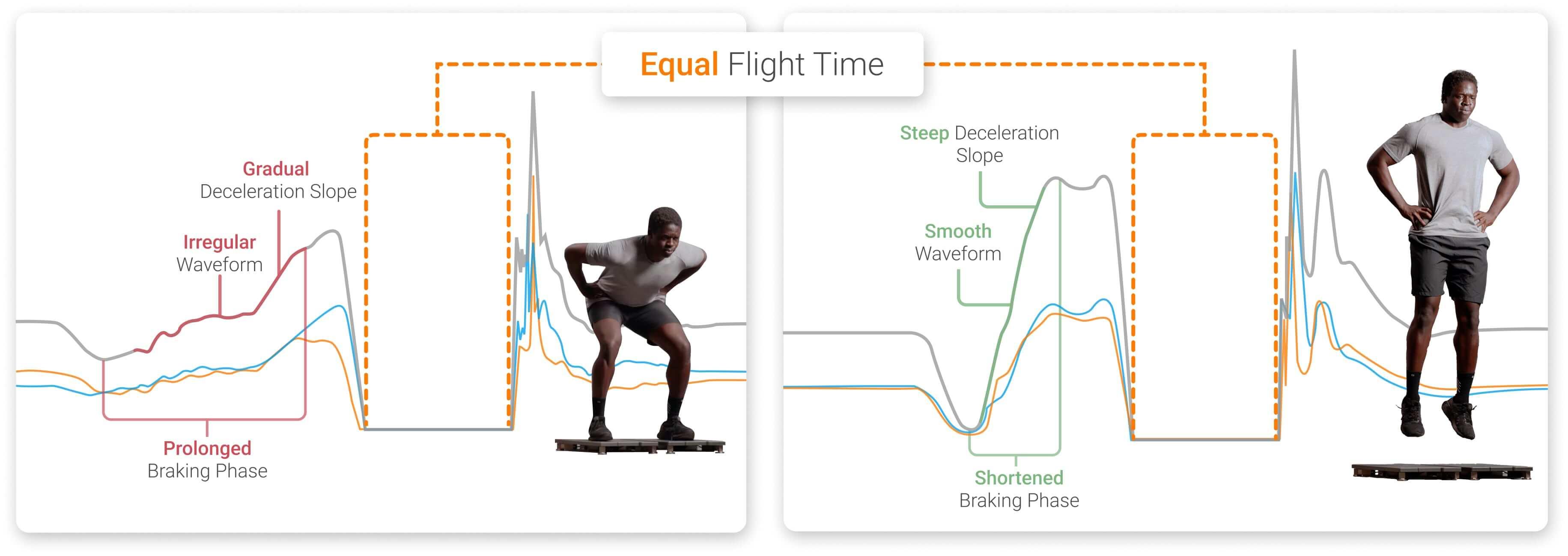
Flight time and jump height may restore before braking strategy and asymmetry.
By aligning our observations with key signals and knowledge of game demands, we can use simple metrics such as EPV and eccentric peak force to ensure qualities like mechanical tolerance and movement confidence are restored within game-specific requirements.
Decide: Choose Under Complexity
Decision-making in elite sport rarely occurs under certainty. We operate amid ambiguity, pressure and competing priorities. This is where second-order thinking, along with reversibility and consequentiality, becomes indispensable.
In basketball, athletes must reduce horizontal momentum within a limited space and time – a task solved through variable strategies. As discussed previously, braking impulse can be achieved through multiple means:
- Short, high-magnitude eccentric decelerations
- Longer, lower-force decelerations
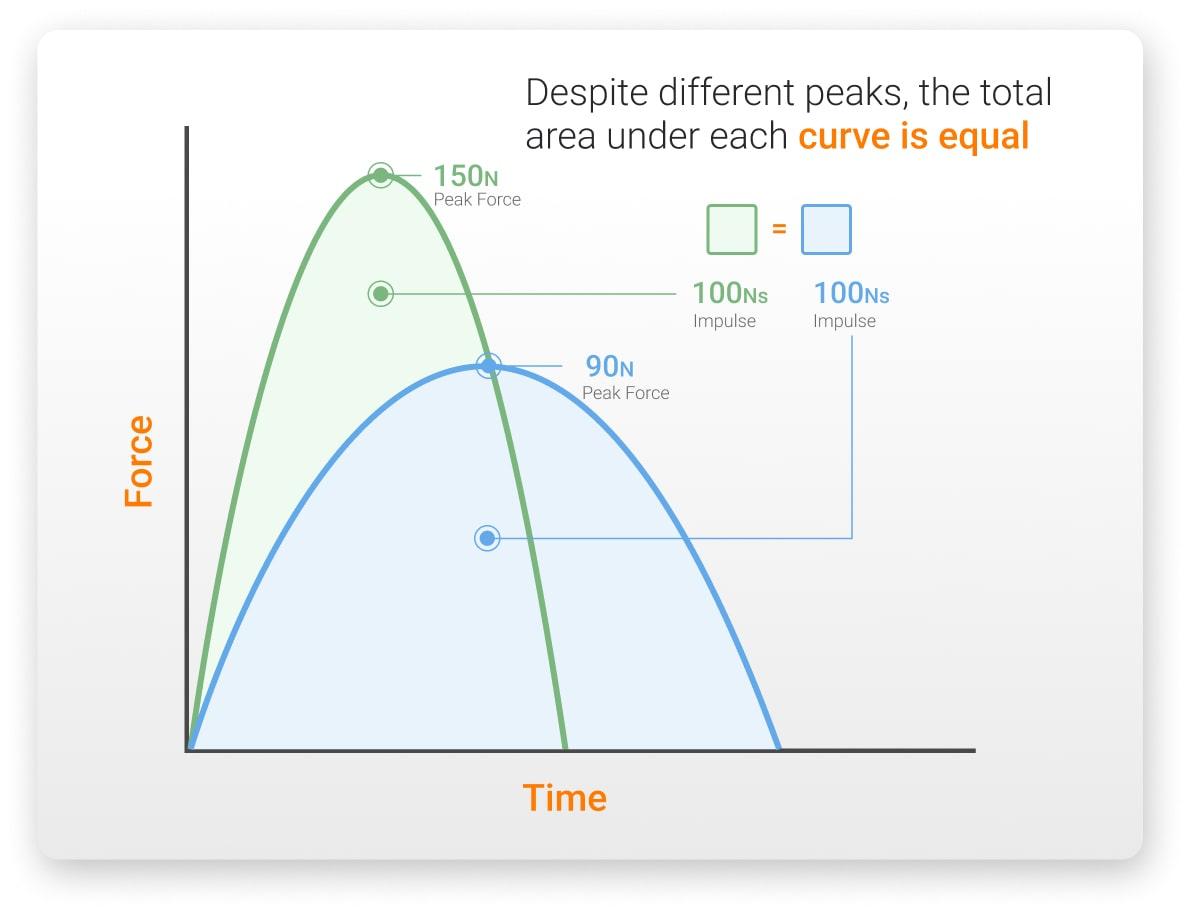
Two different waveforms can have equivalent amounts of impulse.
While impulse is a popular metric, it will remain relatively unchanged in either scenario, masking high-speed deceleration strategy deficits and leaving athletes underprepared for sport demands.
From here, second-order thinking asks: What happens if we are wrong? If our assumptions about athlete readiness are incorrect, does progressing them pose a greater risk than keeping them sidelined?
Reversibility and consequentiality remind us to make decisions proportional to the cost of error.
Reversibility and consequentiality remind us to make decisions proportional to the cost of error.
Act: From Strategy to Stimulus
The Act phase is where decision becomes execution. It is about delivering inputs that shift constraints and produce adaptations. This phase encourages practitioners to pay attention to lead and lag indicators:
| Indicator | Definition | Example |
| Lead | Early changes that provide quick feedback on adaptations that are likely to develop. |
|
| Lag | Known physical adaptations that have accumulated over the course of a training block. |
|
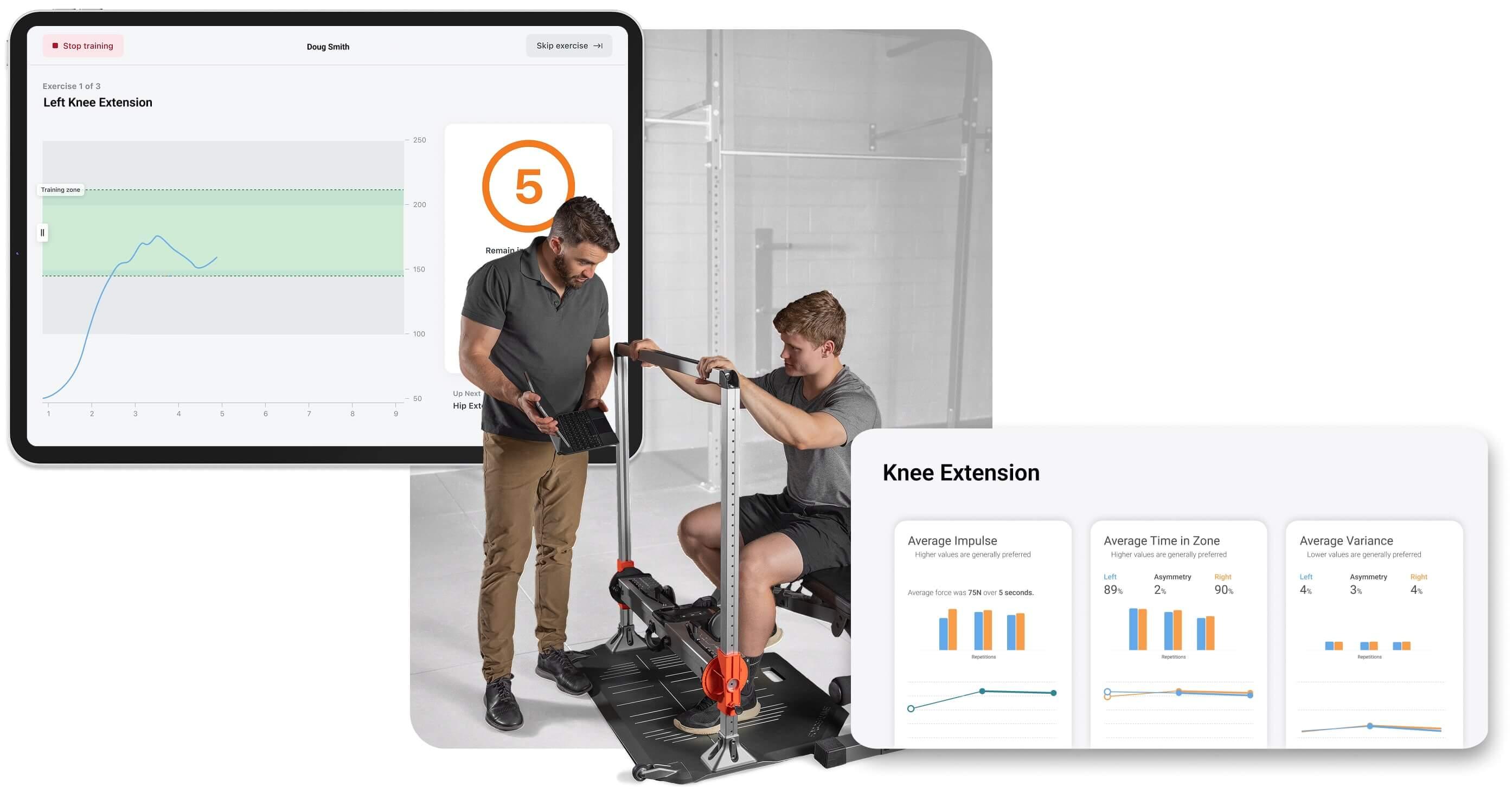
Athlete using ForceFrame Training Mode to improve knee extension strength and control.
In high-performance sport, satisficing – delivering a “good enough” input at the right time – is often more effective than chasing a perfect intervention delivered too late. The priority is to make the next most useful choice based on what matters most, with the goal of driving meaningful change in the intended output.
…delivering a “good enough” input at the right time is often more effective than chasing a perfect intervention delivered too late.
Lead indicators play a key role here, offering early confirmation that the intervention is influencing the right system. They give practitioners confidence that lag indicators, such as restored eccentric impulse or improved deceleration symmetry, will follow as a result of timely, targeted action.
Case Example: Lateral Defender with Groin Symptoms
Consider an elite perimeter defender who excels in lateral maneuverability. Over time, repeated high-volume decelerations during practice and under game demands can lead to groin pain.
As practitioners, we can use the OODA loop to distill a complex case into simple, manageable solutions:
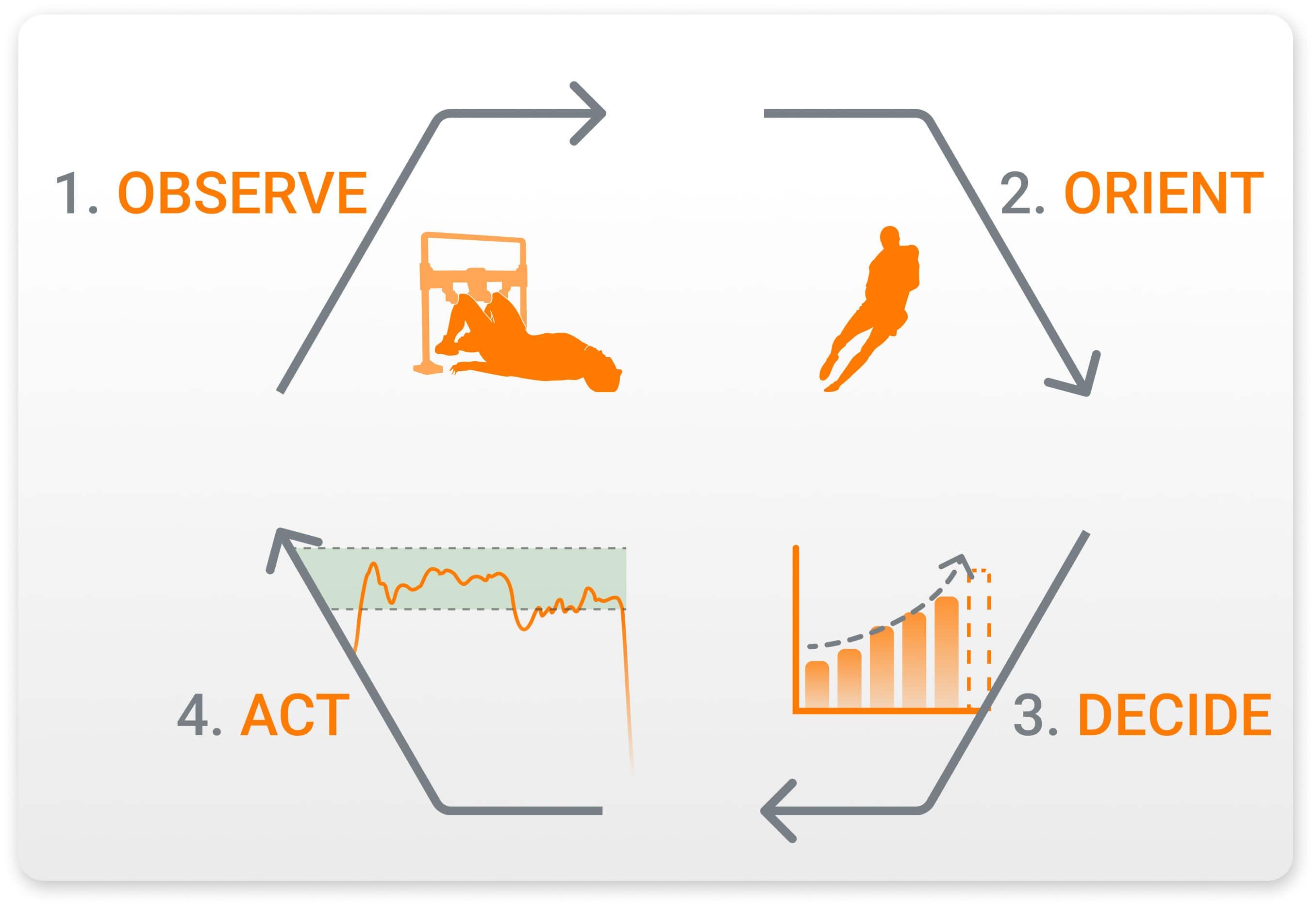
As practitioners, we can use the OODA loop to distill a complex case into simple, manageable solutions…
- Observe: Start with ForceFrame adduction squeezes at 0°, 45° and 90° hip flexion to localize tolerance loss. Triangulate results from isolated tests with countermovement jump (CMJ) metrics, passive range of motion and subjective markers like discomfort during split squats to formulate a comprehensive, yet streamlined, dashboard.
- Orient: Apply Occam’s Razor by recognizing that elevated frontal-plane demands, symptom location and range of motion restriction point toward the adductor longus as the limiter. Frameworks such as the Physical Stress Theory remind us that tensile stress during high-speed COD is the likely culprit. Moderators like poor abdominal load-sharing may further bias stress toward the adductor.
- Decide: Follow first principles thinking by progressing mechanical loading from static to dynamic, inner-range to outer-range, then from duration-derived impulse to peak and finally rate-derived force expressions. We must also anticipate second-order effects; for example, neglecting trunk conditioning may limit comprehensive tissue capacity and perpetuate localized strain.
- Act: Deliver high-fidelity stimulus constrained by location and sport-demanding qualities. Progress isometrics for pelvic load tolerance, complemented by multi-planar lunge derivatives and frontal plane deceleration exposures that closely mirror the mechanical demands of the athlete’s role.
Repeat the loop throughout the rehabilitation process to monitor progress using lead and lag indicators.
Final Thoughts
Decision-making in high-performance sport is not about finding the perfect metrics; it is about constructing the right context, using the right model and selecting the next actionable and adaptive input.
Decision-making in high-performance sport is not about finding the perfect metrics; it is about constructing the right context…
Mental models do not guarantee perfect outcomes, but they can improve coherence in uncertain environments. By merging technology-derived data with frameworks rooted in first principles, we increase our probability of avoiding cognitive trapdoors and inadvertent setbacks.
If you would like to learn how VALD’s ForceDecks and ForceFrame can help you make better-informed decisions through objective assessment and actionable insights, get in touch with our team.
